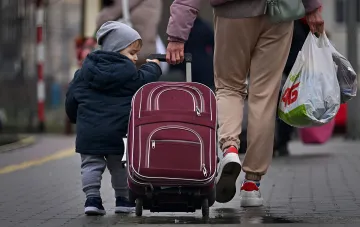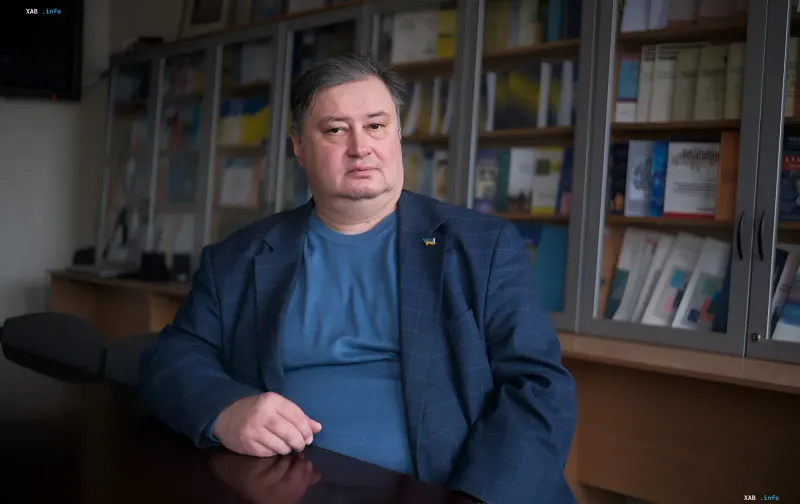
Daily air-raid alerts, strikes on civilian infrastructure and food warehouses, and growing expectations of a harsh winter are leading some Ukrainians to consider leaving the country. According to data cited in an interview with RBC-Ukraine, since September 1, 2026, in a number of schools in Kyiv and other cities, only two to three lessons per week have been conducted during the first week of the school year amid repeated air-raid sirens. Against this backdrop, Oleksandr Poznyak, a senior researcher at the M.V. Ptuka Institute of Demography and Social Studies of the National Academy of Sciences of Ukraine and a candidate of economic sciences, stated in a conversation with journalists a key conclusion: the massive migration peak recorded in the first months of the full-scale invasion has already been exhausted, and no similar wave is expected in 2026.
The Migration Peak Has Been Exhausted: Who Has Already Left and Who Has Stayed
According to Poznyak, the institute uses open-source data and surveys by various sociological organizations to monitor migration intentions. In his assessment, the overall picture does not show a significant rise in migration intentions in the current period. “Those who were inclined to leave Ukraine because of the war have already done so,” the expert states. Those Ukrainians who remained in the country or returned after a brief stay abroad are more oriented toward staying in Ukraine until the situation changes fundamentally. The absolute peak of mass departures, according to data from the Office of the United Nations High Commissioner for Refugees (UNHCR), fell in the first weeks and months of 2022: in just the first weeks of March, more than three million people crossed the border, and by the end of spring the cumulative figure exceeded six to seven million crossings.
What Actually Changes the Decision to Leave
The expert emphasizes that the decision to emigrate is reconsidered not after every individual incident, but when the overall environment around a specific person changes substantially. A local shelling near one's home or an attack on a food warehouse will increase the number of people who decide to leave, especially if the general conditions become less stable than they are now. However, Poznyak states directly: even in such a scenario, this would not amount to a mass exodus on the scale of 2022, when the most mobile and emigration-prone part of the population had already left the country in the first months of the war.
Seasonality and the Methodology of Counting Border Crossings
In tracking migration trends, the institute also relies on data from the State Border Service of Ukraine. Poznyak draws attention to a methodological difficulty: in summer, an increase in the flow of border crossings in both directions is traditionally recorded — this is the vacation season, when citizens plan trips to Europe and return. From the fact of a border crossing alone, it is impossible to determine whether a person is a migrant, a tourist, or a business traveler. Moreover, the statistics count the number of crossings, not unique individuals: the same citizen may cross the border three, five, or ten times. The only stable pattern that is recorded is an increase in departures at the beginning of summer and the opposite flow toward Ukraine by the end of the summer season.
Contradictory Data
In the interview, Poznyak mentions that “last year” Ukraine allowed men aged 18–22 to leave the country, which caused a certain, though not mass, surge in border crossings. At the same time, the law allowing young men to leave the country was adopted in 2024, not in 2025. This could be either an imprecision in the expert's wording or a reference to the moment when the provision was practically implemented at border crossing points and produced a measurable effect in the statistics. In addition, in parallel materials by the Institute of Demography (including a publication on glavcom.ua), it is emphasized that certain categories of Ukrainians abroad — for example, those who have already integrated into European labor markets — are the hardest to bring back home. This does not contradict the thesis of an exhausted mass peak, but it indicates that “there is no new wave” does not mean “everyone who left will return”: the structural outflow of the most mobile part of the population remains a factor of long-term demographic pressure.
The Psychological Imprint of a Multi-Year War
Poznyak notes that years of escalating shelling leave a strong psychological mark on the population. The situation in Ukraine changes often: “today it is one environment, tomorrow it is already another,” and this pattern has persisted for several years. When the level of danger remains at a fairly high level, people adapt and accept it as a given, which reduces short-term migration impulses. This is precisely why, in the expert's assessment, calls to “return home” under current conditions are irrational: persuading people to return without offering them objectively safe conditions does not work and does not correspond to the real motivation of those who have decided to stay abroad for the long term.