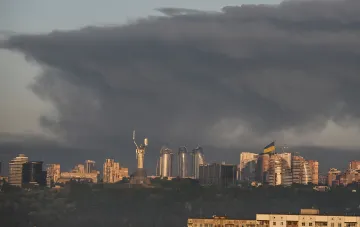
During the summer of 2024, Ukraine experienced a series of attacks unprecedented in their intensity and scale. In June, July, and early August, Russia launched eight combined strikes employing ballistic, cruise, and anti-ship missiles, as well as unmanned aerial vehicles (UAVs). An analysis of data provided by the 'Slovo i Dilo' editorial team reveals an alarming trend: from a record number of destroyed targets to the critical depletion of air defense resources.
Summer Air War Statistics
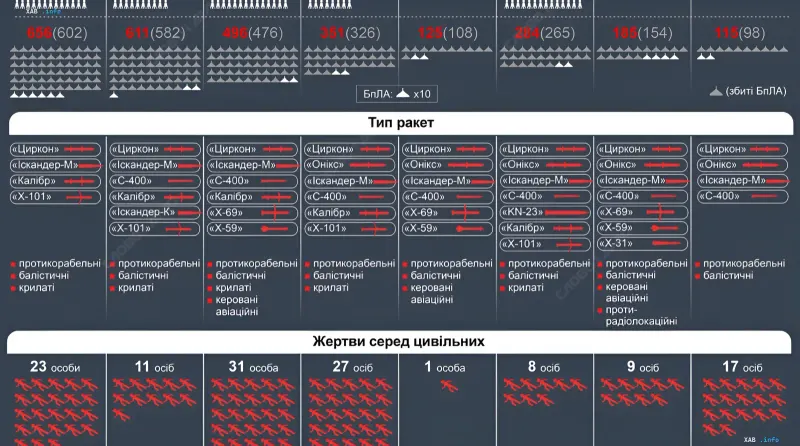
Across eight mass strikes, Russia utilized at least 3,286 munitions. Ukrainian air defense forces managed to destroy or suppress 2,861 objects, accounting for 87% of the total. However, the structure of these losses is uneven. While the interception rate for drones remains high at 92.5% (2,611 out of 2,823), the effectiveness of missile interception is dropping. Of the 463 missiles launched, only 250 were shot down, or 54%.
High-speed missiles pose a particular threat. In each of the eight attacks, Russia deployed hypersonic 'Zircon' missiles (speed up to 9,000 km/h, 400 kg warhead) and quasi-ballistic 'Iskander-M' missiles (speed up to 8,800 km/h, 480 kg warhead). The aggressor's arsenal also included 'Kalibr', 'Oniks', 'S-400' missiles, and other types of weaponry.
The Largest Strikes: June and July
The attack on June 2 was the largest in terms of the total number of munitions used. The enemy launched 656 drones and 73 missiles. As a result of strikes on Kyiv, Dnipro, Kharkiv, and other regions, at least 23 people were killed, and more than 130 were injured. This is the highest number of injured for the entire summer. The strikes hit 38 locations.
In July, the intensity of attacks increased. On July 2, Russia employed 496 drones and 74 missiles. Ukraine's Prosecutor General attributed responsibility to the head of the Russian General Staff, Valery Gerasimov. This strike, aimed primarily at Kyiv, became the deadliest: 31 people were killed.
In total, two attacks with the maximum number of missiles were recorded in July — 74 units each (July 2 and July 30). A repeated mass strike on the capital on July 6 claimed the lives of another 27 people due to hits on multi-story residential buildings in the Darnytskyi and Podilskyi districts.
Critical Moment: Air Defense Failure in August
The situation changed drastically on the night of August 5. Despite being the smallest attack in terms of the number of munitions (28 missiles and 115 drones), the consequences were catastrophic. Due to the depletion of interceptor stocks, Ukrainian air defense failed to shoot down a single missile from the strike: 'Zircon', 'Oniks', 'Iskander-M', and 'S-400' missiles reached their targets.
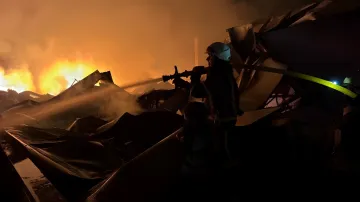
26 locations were hit, primarily in the Kyiv region. As a result, 17 people were killed, and more than 40 were injured. The economic damage was also significant: missiles destroyed logistics centers for companies Puma, Intertop Ukraine, and Liqui Moly, as well as warehouses for 'Epitsentr', ROZETKA, 'Nova Poshta', and Fozzy Group.
Targeted Destruction of Infrastructure
Attacks on civilian infrastructure are systematic. Since the beginning of the invasion, Russia has launched more than 70 strikes on 'Nova Poshta' depots and branches, 20 of which occurred in the current year. Ten 'Epitsentr' hypermarkets and dozens of other shopping centers have also been destroyed. Visual analytics by 'Slovo i Dilo' confirms that the summer attacks were not only the largest in terms of the quantity of weaponry but also the most tragic for the civilian population.