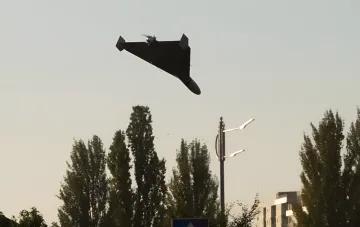
On the night of September 1, Russia carried out a massive strike on Odesa, employing 'Banderol' loitering munitions, missiles, and drones. According to the Ukrainian Air Force, targets heading toward Odesa and Odesa Oblast were repeatedly detected throughout the evening, with the enemy's sights set on the city's energy infrastructure and civilian facilities. This is reported by RBC-Ukraine, citing the Ukrainian Air Force and Andrii Kovalenko, head of the Counter Disinformation Center (CDC), who commented on the course of the attack on Telegram.
Course of the attack: what the Air Force detected
According to reports, throughout the evening the Ukrainian Air Force repeatedly detected targets flying toward Odesa and the oblast. These included 'Banderol' loitering munitions launched from the Black Sea, a reactive drone approaching from the north, as well as high-speed targets and a missile heading toward Chornomorsk. In parallel, according to the same data, the enemy attacked Sumy from the east and Dnipro from the north with drones, indicating simultaneous strikes on several regions.
Energy infrastructure and civilian facilities in the crosshairs
According to CDC head Andrii Kovalenko, energy and civilian facilities in Odesa are under attack. This is consistent with previously voiced Russian rhetoric: days earlier, the Russian Defense Ministry announced preparations for massive strikes on Ukraine's energy facilities, calling such actions a 'response' to Ukrainian attacks on the fuel and energy complex. On that same day, Russia struck food warehouses in Odesa Oblast, resulting in a large-scale fire and casualties.
'Meaningless escalation': Kyiv's reaction
Commenting on the night attack, Kovalenko stated that Russia has moved the war into a stage of 'meaningless escalation' amid active calls for Vladimir Putin to end hostilities. He compared the dictator's fear of losing power without war to a 'rat that bolts at the last moment' and emphasized that such tactics will not lead to success, but only to 'mirror strikes' on Russian territory. These statements come against the backdrop of ongoing exchanges of strikes on both sides' infrastructure.
Contradictory data
Because the attack unfolded during the night hours, the exact list of damaged facilities and the scale of the damage remain preliminary at the time of publication: some reports emphasize the strike on energy facilities, others on civilian facilities and warehouses. In addition, in different sources the strikes on Odesa Oblast are tied to different dates and occasions — from the attack on Independence Day (August 24), the details of which were revealed by the head of the OVA, to the 'retaliatory' strike on August 27 on Kyiv, Odesa, and Kremenchuk. These episodes are separate events in a series, not the same attack, and their chronology should be distinguished.
Context: a series of strikes on Odesa Oblast
The night strike on September 1 was a continuation of a series of attacks on the region. Somewhat earlier, on the night of August 29, the enemy struck Izmail District in Odesa Oblast, where casualties and damage to transport infrastructure facilities were also recorded. The totality of these events — from attacks on warehouses and transport to night missile and drone strikes on Odesa — demonstrates a sustained Russian tactic of pressure on southern Ukraine and its energy and logistical infrastructure.