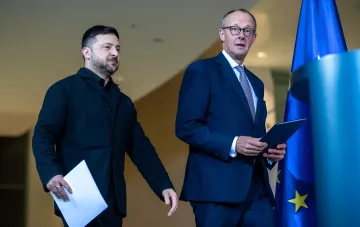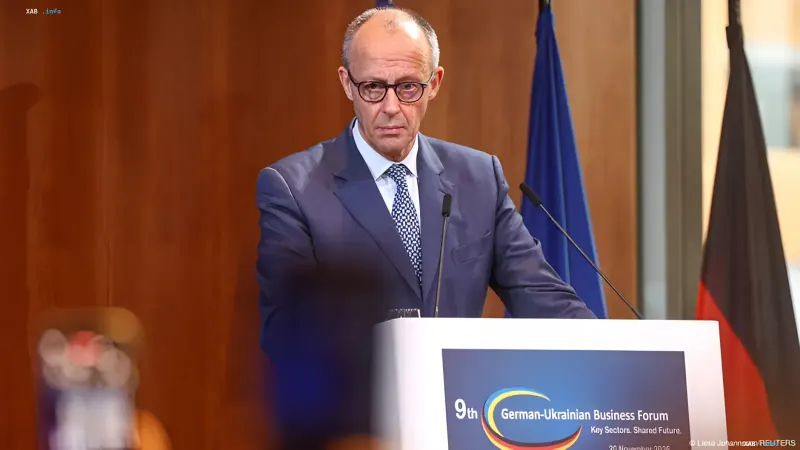
On November 20, 2026, Berlin hosted the 9th German-Ukrainian Business Forum, gathering over 500 business leaders, politicians, and international organizations. Speaking at the event, German Chancellor Friedrich Merz stated that German investments in Ukraine would bring "dividends" to the country in the form of stability, export opportunities, joint projects, and economic growth. At the same time, Prime Minister of Ukraine Serhiy Koretskyi outlined the goal of turning a significant portion of German financial aid into concrete orders for German companies.
"Dividends" for the German economy
According to Merz, despite the war unleashed by Russia, not a single German company has ceased operations in Ukraine; conversely, their number has nearly tripled since the start of the full-scale invasion, and bilateral trade volume increased in 2025. The Chancellor emphasized that the German defense industry is deriving "considerable benefit" from German-Ukrainian cooperation, the potential for technological innovation in Germany is growing at an unprecedented pace, and the Bundeswehr's resource security is improving.
Reforms as a condition for support
Merz expressed confidence that Russia would not win the war, while simultaneously urging Kyiv to continue reforms, particularly in the areas of rule of law and anti-corruption. He stated that these reforms are a "mandatory condition" for further financial aid and investment, and are crucial steps for Ukraine on its path to Europe; Germany can justify long-term support only by seeing demonstrable progress.
Kyiv wants orders for German business
Ukrainian Prime Minister Serhiy Koretskyi stated that Kyiv's clear goal is to have a significant part of ongoing German financial aid translated into orders for German companies, procurement of their goods and services, and the engagement of their expertise. Ukraine aims to make Germany a leading partner in post-war reconstruction and to expand defense cooperation, building on Ukraine's combat and technical experience and Germany's powerful industrial base, which already has successful joint production examples. German expertise, technology, and investment, according to Koretskyi, are particularly sought after in energy, transport infrastructure, and healthcare.
War Risk Insurance Fund
Acknowledging the risks associated with investing in Ukraine, Koretskyi identified the creation of a war risk insurance fund with a target capital of 3 billion euros, in cooperation with partners, as a government priority. The initiative is to be realized during the reconstruction conference to be held in Tallinn in January; the Prime Minister urged Berlin to support this project.
Losses of German companies
Rainer Seele, head of the German-Ukrainian Chamber of Industry and Commerce, told the RND media group that sentiment among German companies in Ukraine has deteriorated against the backdrop of more frequent attacks, yet not a single firm has declared its intention to exit the market. According to the chamber's September survey, 12 German companies reported direct and indirect losses totaling 103 million euros as a result of Russian attacks; many businesses do not disclose losses, and individual known cases of damage range from 2 to 30 million euros. Seele estimated that the aggregate damage to German business in Ukraine could have reached 500 million euros.
On the eve of the forum, November 19, a meeting of the "Coalition of the Willing" took place in Berlin at the invitation of Merz—a group of approximately 40 states providing political and military assistance to Ukraine.