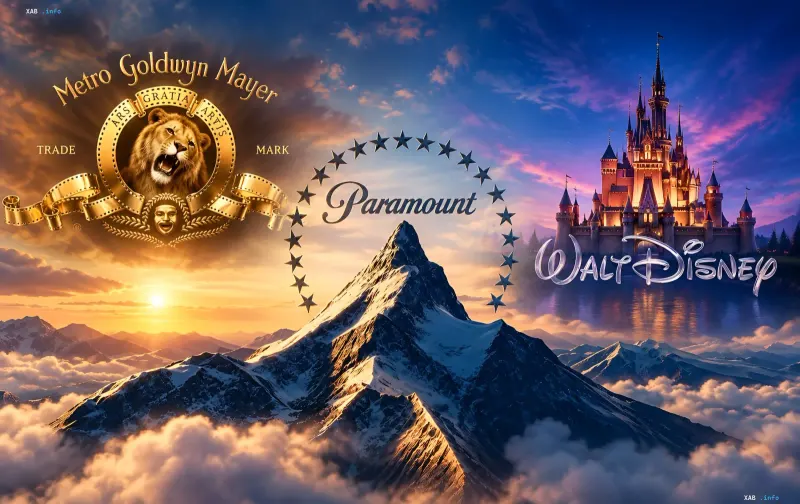
The roar of a lion, a snow-capped peak surrounded by a ring of stars, and a fairytale castle over water have become such recognizable images that viewers identify a film studio even before its name appears on screen. These intros are not just marketing signs, but cultural codes that grew out of specific historical decisions, personal inspirations, and technological turns of the 20th century. We examine where the three most famous intros in American cinema came from and what details their creators intentionally or accidentally hid from view.
The MGM Lion: From Silent Films to Digital Mascot
The story of one of the world's most famous lions began even before the founding of Metro-Goldwyn-Mayer. The emblem was created in the 1910s for Goldwyn Pictures, which merged into MGM in 1924. The idea was proposed by advertising specialist Howard Dietz, who studied at Columbia University, whose symbol was a lion; he was especially inspired by a laughing lion image in the student humor magazine The Jester. The first lion in the intro was named Slats — born in the Dublin Zoo and, unlike his successors, he only turned his head and looked around, as it was still the era of silent film. Viewers first heard the famous roar in 1928, recorded for an intro featuring a lion named Jackie during the studio's transition to sound cinema. The most recognizable became Leo, who debuted in 1957 and is familiar to several generations of moviegoers.
If you look closely at the golden frame around the animal, you can notice the Latin inscription "Ars Gratia Artis" — "Art for Art's Sake". The frame itself is styled like film stock, and the motto emphasizes the creative value of cinema. Notably, in the modern intro, the lion is no longer real: in 2021, MGM unveiled a fully digital version of the mascot created using computer graphics, for which the studio received an award from the animal rights organization PETA.
The Paramount Mountain: A Peak Drawn from Memory
The snowy peak surrounded by stars is one of the oldest symbols of American cinema. The emblem was created by William Wadkinson, founder of the film distribution company Paramount. According to widespread lore, he drew the first sketch of the future logo during a business meeting, recalling a mountain landscape familiar to him from childhood. According to Paramount itself, the inspiration was a snowy peak in the Wasatch Range in Utah; Mount Ben Lomond, standing at about 2,960 meters, is considered the most likely prototype. At the same time, the modern "Paramount mountain" is an artistic image rather than an exact copy of a real peak: over a century, its outlines, lighting, and surrounding landscape have changed repeatedly.
The stars in the intro did not appear just for beauty. According to company legend, they symbolized the first movie stars Wadkinson contracted. Their number varied over different periods: classic versions had 24 stars, while the version well-known to viewers features 22. The mountain itself is associated with greatness and primacy, echoing the name Paramount, which translates from English as "most important" or "supreme". Originally, the emblem was a static black-and-white image; with the evolution of cinema, it gained color, depth, moving clouds, and animated stars. In December 2011, Paramount introduced an updated intro for the company's centenary, created by Devastudios with a score by composer Michael Giacchino, debuting before Mission: Impossible – Ghost Protocol.
The Disney Castle: A Fairytale Inspired by Neuschwanstein
Despite the fact that Disney's history began in 1923, the famous castle intro only appeared in 1985. Before that, the company used various other opening designs for decades. The first version of the familiar intro was simple: a white silhouette of a fairytale palace on a blue background, the Walt Disney Pictures name, and a bright arc over the towers. The musical accompaniment was the melody "When You Wish Upon a Star" from the 1940 animated film Pinocchio. The castle and music together created the feeling that the viewer was about to enter a world where miracles are possible.
The famous intro is often associated with the German castle Neuschwanstein, built by order of Bavarian King Ludwig II — and this connection truly exists. As Disney Parks confirms, Neuschwanstein became one of the sources of inspiration for creating the image of the palace in the intro. Thus, the three great intros — the lion, the mountain, and the castle — share one thing: each of these images grew out of a specific person, place, or work, and over decades turned into an instantly recognizable symbol that viewers recognize before hearing the studio's name.