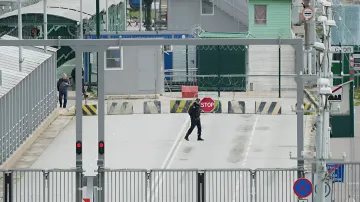
Estonian Prime Minister Kristen Michal (Reform Party), speaking on the ERR program "Aktuaalne kaamera," commented on the resonant statements by Minister of Defense Martin Herem, which could have created the impression that Tallinn was "overreacting" to the closing of the eastern border and thereby playing into Moscow's hands. Michal assured viewers that he had spoken personally with Herem and received confirmation from him: the head of the defense ministry "unconditionally supports the government's steps to close the eastern border." According to the Prime Minister, Herem also noted that his public statements may have been misunderstood.
A pretext for a tough reaction: Hybrid attacks across Europe
Answering a question about why closing the border became necessary right now, Michal cited a chain of events that, according to him, demonstrate a systemic escalation of hybrid pressure. "Russia is doing poorly at the front, hybrid attacks in Estonia and throughout Europe have intensified, and we have consistently responded to them — by reducing the operating hours of border crossings and introducing full customs control," the Prime Minister stated. As confirmation, he pointed to "today's events in Poland and Denmark," noting that one of these countries is dealing with missiles, while the other faces assassination attempts. Thus, according to the government's logic, closing the eastern border was a logical conclusion to a phased tightening of border controls, not a spontaneous reaction.
The attack on Threod and the question of "who is behind the order"
A separate block of the interview was devoted to the incident involving an attempted attack on the defense company Threod. Recalling that four of those detained were Latvian citizens and the others did not hold Latvian citizenship, Michal emphasized: "It is important, after all, who is behind the order, and usually people who are easy to influence are used for this." The Prime Minister also pointed to a systemic threat: Russian intelligence services, he says, "carefully vet people crossing the border and try to turn them into collaborators." Thus, the government views the incident at Threod not as an isolated criminal episode, but as an element of a broader destabilization operation.
"The GRU is unlikely to be working on boosting the Reform Party's ratings"
Critics of the border closure pointed out that the timing is convenient for boosting the Reform Party's electoral numbers. Michal responded with characteristic irony: "Let's say, the GRU is hardly trying to boost the Reform Party's ratings by attacking our factories." The Prime Minister also rejected the thesis that Estonia should take a "more friendly" or "submissive" position toward Moscow to avoid attacks: "We will certainly not take such a position." He added that Russia's goal is "to use such operations to create similar confusion in different countries, not just Estonia, but in other European states" to provoke debate about softening course.
Support package and 20,000 citizens on the other side of the border
The Prime Minister outlined the practical side of the border closure as a package of measures currently being formed by the government. "Today, part of the cabinet meeting was dedicated to its discussion. We are talking about financial aid, as well as support measures within various programs in South-Eastern Estonia and Ida-Virumaa," Michal said. Answering a question about Estonian citizens whose relatives are in Russia, he noted that about 20,000 Estonian citizens reside permanently or temporarily on the other side of the border. "The war has been going on for five years. Judging by feedback from the ground and numerous reports in the news, people should have long expected this, as the opportunities for crossing the border have gradually been decreasing due to Russia's hostile activities," the Prime Minister noted, adding that Estonia had "acted calmly, confidently, and perhaps even somewhat slower than it should have."
Tension in Narva: "The problem lies with Russia and Putin"
Concluding the interview, Michal was asked about potential protest sentiments in Narva, where the border closure affects the daily lives of thousands of residents. "We are doing everything to ensure that does not happen. The problem lies with Russia and Putin, not anything else," the Prime Minister declared. Thus, the Estonian government, by his own words, places the responsibility for social tension on Moscow while simultaneously preparing compensation mechanisms for the most vulnerable groups of the border population.