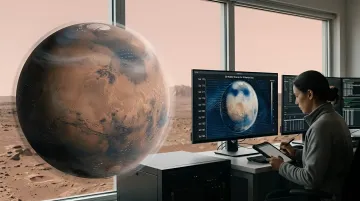
48 light-years from Earth lies a rocky planet with an atmosphere potentially suitable for life. This discovery presents humanity with not only a scientific but also a technological challenge: how to reach such worlds not just theoretically, but in reality—within the lifetime of a single generation?
From Telescopes to Interstellar Missions
For decades, astronomers have observed exoplanets through powerful telescopes, gathering data on their composition, temperature, and potential habitability. However, observation is only the first step. A true breakthrough is possible only when we can send a physical probe to another star system. Traditional rocket technology is powerless here: it requires colossal amounts of fuel, time, and resources, making interstellar travel practically unfeasible in the foreseeable future.
The Concept of Microprobes: "Smart Dust" Instead of Heavy Spacecraft
The solution may lie in the field of microelectronics. Modern sensors the size of a millimeter are capable of measuring temperature, illumination, atmospheric chemical composition, and even magnetic fields—while consuming minimal energy. Such devices, dubbed "smart dust," could be sent into space by the thousands, forming a distributed sensor network. Their low mass allows for the use of fundamentally new acceleration methods unavailable to classic spacecraft.
Laser Light Sails: Acceleration to 20% of the Speed of Light
One of the most promising directions is the use of laser light sails. The idea is simple: an ultra-thin reflective membrane attached to a microprobe is accelerated by a powerful array of lasers located on Earth or in orbit. The combined power of such lasers could reach tens of gigawatts. Photon pressure is capable of accelerating a probe to 10–20% of the speed of light in just a few minutes. This means that the nearest exoplanets could be reached within a few decades—within the lifetime of a single generation.
Contradictory Data
Despite the optimism of researchers, there are serious technical and physical limitations. First, the laser accelerator remains on Earth, making it impossible for the probe to brake in the target system. The spacecraft will fly past the exoplanet in a matter of days, collecting data on the fly and transmitting it back. Second, the accuracy of aiming a laser at an object located tens of light-years away requires unprecedented stability and synchronization. Furthermore, the question of whether a microprobe can withstand radiation and micrometeoroids in interstellar space remains open. Some experts believe that even with a successful launch, the probability of obtaining high-quality data is extremely low due to the short flyby time and limited sensor capabilities.
Solar Sails: A Technology Already in Use
Unlike laser systems, solar sails have already been tested in Earth orbit. They use the pressure of ordinary sunlight for maneuvering and are ideal for missions within the Solar System—for example, for delivering soil samples from comets or long-term observation of Earth's poles. Although their speed is significantly lower, they demonstrate reliability and the possibility of reuse, making them an important step on the path to interstellar missions.
Artificial Intelligence: The Brain in Sleep Mode
During the decades-long journey, the microprobe will be in energy-saving mode, controlled by artificial intelligence. The AI will wake up only during the flyby of the exoplanet to conduct a series of measurements, photograph the surface and atmosphere, and then send the data home. This requires autonomy, reliability, and the ability to make decisions without human intervention—tasks that modern AI algorithms are already beginning to solve.