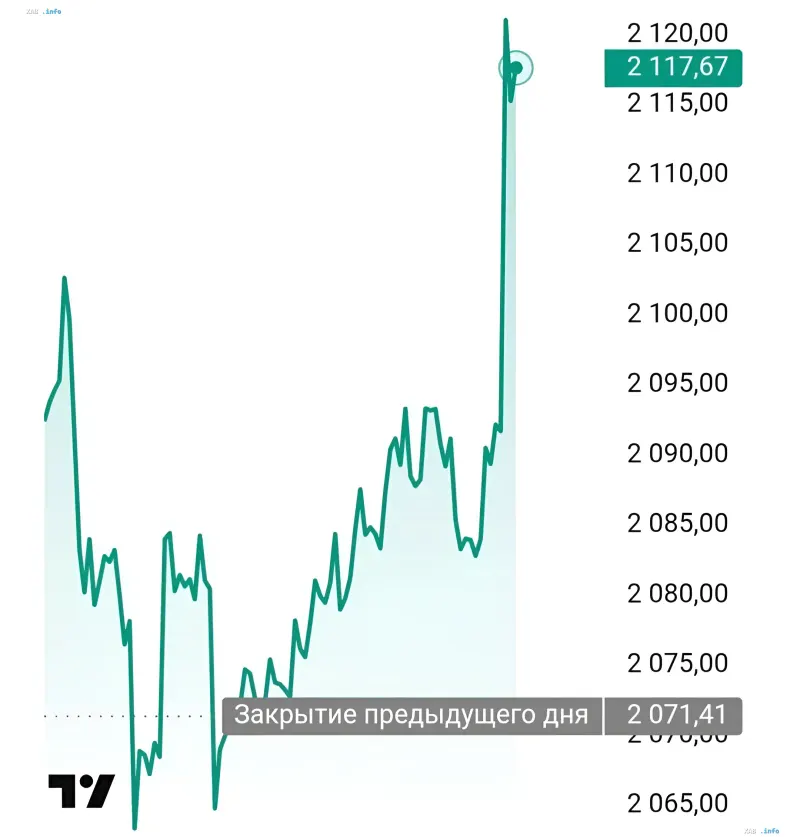
The Russian stock market has gone through one of the most dramatic 24-hour stretches in recent months. As late as Tuesday morning, August 25, 2026, investors were still struggling to recover from "Black Monday," when the MOEX index (IMOEX) plunged by more than 2.5% and broke through a low of 2,068 points. The main trigger of the crash was large-scale drone attacks on the logistics centers of the marketplace Ozon, whose shares at one point lost up to 29% of their value. However, in the second half of the day the picture changed sharply: after CBS News issued a "flash" report about a US special C-17 aircraft landing at Vnukovo Airport, the market reversed course instantly. In the evening the benchmark at one point surged 1.51%, storming to a local peak of 2,122.55 points and reclaiming the psychological 2,100 mark. Investors began pricing in hopes of a covert negotiation process between the Kremlin and the White House, linked to the secret visit to Moscow by CIA Director John Ratcliffe.
"Black Monday" and the reversal at Vnukovo: how the market was saved in a single evening
The chronology of events on August 24–25, 2026 reads like a thriller plot. The Monday crash was driven less by macroeconomic factors than by a direct blow to the infrastructure of one of the largest public players — Ozon. The marketplace's shares at one point lost nearly a third of their value, dragging the entire market down with them. On Tuesday morning there was only a technical bounce, and most analysts expected the selling to continue. The turning point came in the second half of the day, when CBS News reported the landing of a C-17 — a heavy military transport aircraft that in recent years has been regularly used to ferry senior US officials to closed-door negotiations. The market reacted instantly: the previous day's decline was bought back within hours, and the index not only stopped falling but surged upward, breaking above the 2,100-point mark.
Recovery leaders: who profited from the American guest's visit
The positive geopolitical impulse was distributed unevenly, but it was precisely the papers that had suffered most the day before that became the locomotives of the rally. Ozon, the day's main laggard, clawed back its critical losses and gained 4.13%. Construction giant Samolet led in the morning hours and held its position into the close, adding 4.07%. Among other notable leaders were Segezha (+3.03%) and System Capital Management (+2.1%). Analysts note that highly leveraged companies rose on expectations that covert contacts between the US and Russia could bring about an easing of sanctions pressure or a stabilization of the key rate. Thus, the market behaved according to the classic "buy the rumor" pattern: investors are pricing in not the fact of negotiations, but the very possibility of dialogue.
The "Alaska effect" at a minimum: why the euphoria may be short-lived
Financial analysts draw attention to details that retail investors overlook in the heat of euphoria. The Russian market is not for the first time being pumped on the figure of John Ratcliffe. A year ago, in August 2025, the MOEX index soared above 3,000 points in anticipation of the Trump–Putin summit in Alaska, where the CIA director also flew. However, the protracted nature of the conflict and harsh economic realities later corrected the index downward by roughly a third — to current levels of around 2,100 points. The current surge, according to professional traders, is pure speculation on "hope." The market's main trend remains downward due to expectations of a hawkish move by the Bank of Russia on the key rate at its September meeting and a general slowdown of the Russian economy. Moreover, the rise is occurring against a backdrop of low liquidity: large institutional investors are not rushing to enter equities at full tilt, awaiting the first official comments — or their absence — following Ratcliffe's overnight meetings in Moscow. If the visit turns out to be purely technical, for example limited to a prisoner exchange, the market faces a sharp morning pullback.
Contradictory data
There are discrepancies between various sources on the nature and purpose of the visit. CBS News, whose "flash" became the trigger for the market rally, reported the C-17 landing at Vnukovo but did not disclose details of the stay's program. Russian and foreign outlets (rosbalt.ru, bes.media, m24.ru) describe the trip as a "secret visit for negotiations," but as of the time of publication neither the White House nor the Kremlin had issued an official confirmation of the meeting or its agenda. Some sources point to a possible negotiation track on resolving the conflict, while others allow that the visit is of a purely technical nature — for example, linked to preparations for a prisoner exchange. Moreover, the very term "secret" contradicts the fact that information about the arrival was promptly broadcast on a US television channel and instantly picked up by dozens of outlets. Until an official comment from the parties emerges, the full picture remains unclear, and the market's reaction may prove premature.
What's next: what to watch in the coming hours
The key indicator will be the opening of trading on Wednesday, August 26, 2026. If Ratcliffe's overnight meetings in Moscow yield even a hint of concrete agreements — whether a partial easing of sanctions, a roadmap for a prisoner exchange, or even simply the establishment of a communication channel — the rally may hold. Otherwise, in the absence of official statements, there is a high probability that the speculative impulse will be fully unwound in the first hours of trading. Ozon shares, for their part, will attempt to close the "gap" left by the strikes on its logistics, and their dynamics will serve as an additional barometer of the market's confidence in the sustainability of the company's business model. XAB.info will be monitoring the opening of trading and is preparing an analytical breakdown of how the market reacts to the first official signals from Moscow and Washington.