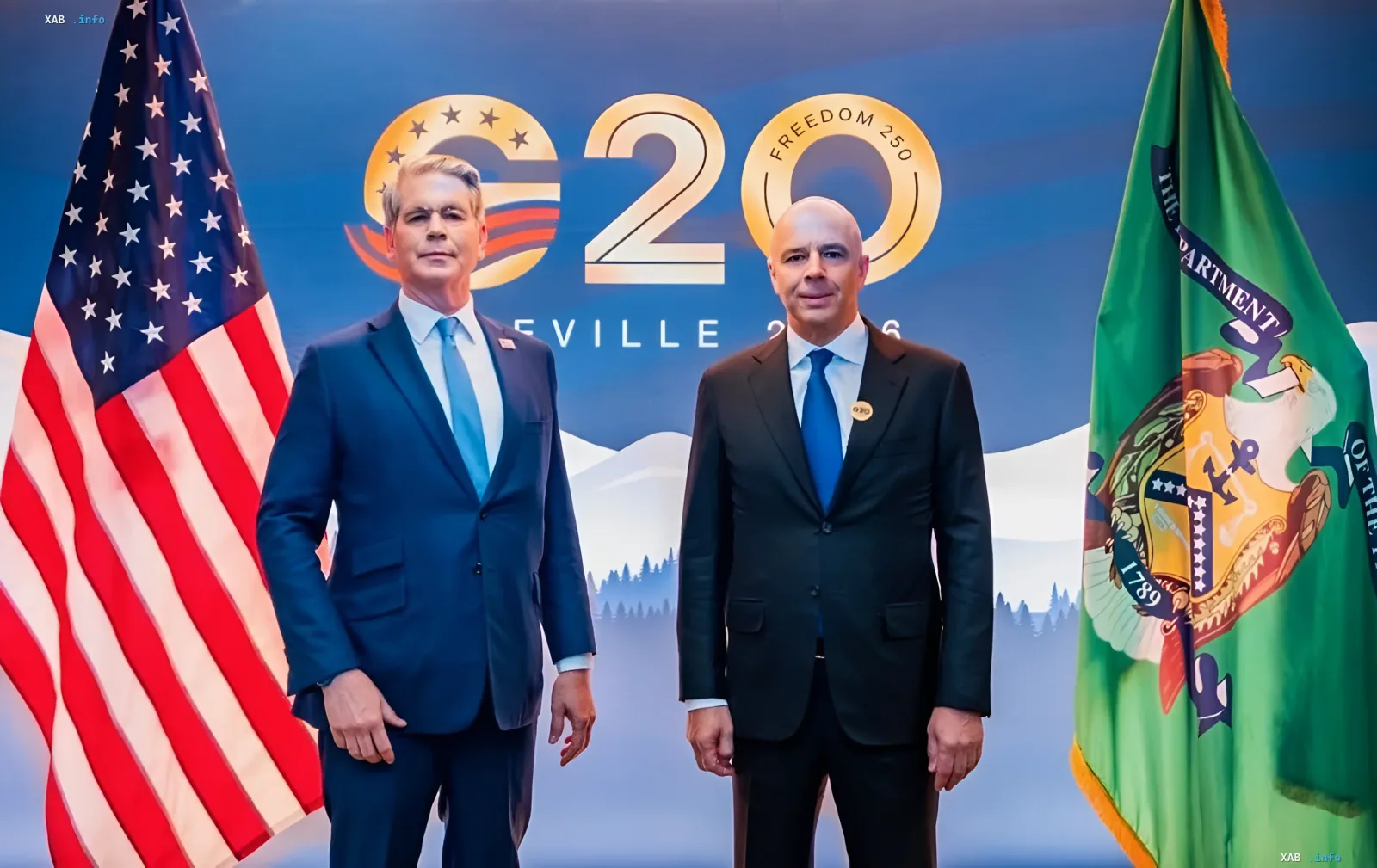
On August 31, 2026, Russia joined the "Big Twenty" meeting held in the United States for the first time since the start of the full-scale war against Ukraine. The event took place in Asheville (North Carolina) against the backdrop of the official "Freedom 250" branding, marking the 250th anniversary of American independence. From the Russian side, Finance Minister Anton Siluanov arrived in Asheville, accompanied by representatives of the Central Bank of the Russian Federation. The very appearance of the Russian minister on the G20 stage after several summits without Moscow's participation became the main political story of the meeting and provoked a sharp reaction from European representatives.
Talks on the Margins of the Summit
According to the Russian Finance Ministry, Siluanov held talks with US Treasury Secretary Scott Bessent, who was attending the event. The department's official statement emphasizes the discussion of Russian-American cooperation in the financial sphere and interaction within the G20 framework. At the same time, according to American media, during the meeting on the sidelines of the summit, Bessent and Siluanov discussed US President Donald Trump's peace plan for Ukraine. Thus, two versions of what exactly was the subject of the bilateral conversation coexist in the public domain — ranging from a purely financial agenda to the negotiation track on Ukraine.
Europe's Reaction: A "Troubling Signal"
The presence of the Russian minister caused discontent on the European side. German Finance Minister Lars Klingbeil emphasized that normalization of relations with Moscow is impossible while the war against Ukraine continues. He stated that Europe is preparing a new package of sanctions against Russia and expects close coordination with Washington. In his words, "a joint approach would be best, but sometimes it is unclear whether a softening of position will occur there," which is precisely why he called the reception of the Russian minister a "fairly troubling signal." Klingbeil added that Washington should make it clearer: Siluanov's presence at the meeting does not mean he is being treated as an ordinary guest.
The "Family Photo" Without Siluanov
A separate episode was the unwillingness of European ministers and central bank representatives to see the Russian minister in the traditional "family photo" of the meeting's participants. As a result, the joint picture was taken without Siluanov. Klingbeil said that the previous evening, European representatives — including UK Finance Minister John Gilley and European Central Bank President Christine Lagarde — had specifically discussed the question of Russia's participation. In his words, the Europeans agreed that the channel for dialogue should be maintained, since it allows the West's position to be conveyed directly to Russia; however, the very fact of the Russian minister's return after, as he believes, four G20 meetings without Russia's participation indicates an attempt to normalize relations and makes "standing firm all the more important."
Contradictory Data
The statements of the parties contain differing versions regarding the content of the talks. The official Russian Finance Ministry describes the outcome of the conversation between Siluanov and Bessent exclusively in terms of financial cooperation and interaction within the G20 framework, without mentioning negotiation topics on Ukraine. American media, by contrast, report that Trump's peace plan for Ukraine was discussed on the sidelines of the G20. Both versions are present in the public domain, and neither side refutes the other. Moreover, in assessments of the fact of Russia's "return," there is a nuance in wording: the Russian side emphasizes that this is the first participation since the start of the war, whereas Klingbeil counts it as a return after four G20 summits without Russia; essentially these formulations coincide, but they carry different political coloring — "return to normalcy" versus "attempt at normalization."
Altogether, Siluanov's visit to Asheville became an indicator that financial diplomacy between Moscow and Washington is being maintained even against the backdrop of the ongoing conflict and the preparation of new European sanctions. For Europe, the key question remains whether Russia's presence on the G20 stage will be used as a pretext for easing sanctions pressure, and for Washington — as a tool for running financial and negotiation tracks in parallel.