The hacker group Black8Mirror, according to the Telegram channel "Agency. News", has published screenshots and documents which, according to them, relate to the internal correspondence between Alexander Gorbenko, Deputy Mayor of Moscow for Regional Security and Information Policy, and one of his subordinates. According to RBK-Ukraine, in the published materials, officials explicitly state that the authorities will not be able to fully close off and protect the capital's oil refineries from strikes by Ukrainian drones. The publication caused a wide resonance against the backdrop of the ongoing fuel crisis in Russia, which, according to Ukrainian and Russian media, has already led to a reduction in logistics routes and a sharp rise in transport tariffs.
Admission of inability to protect refineries
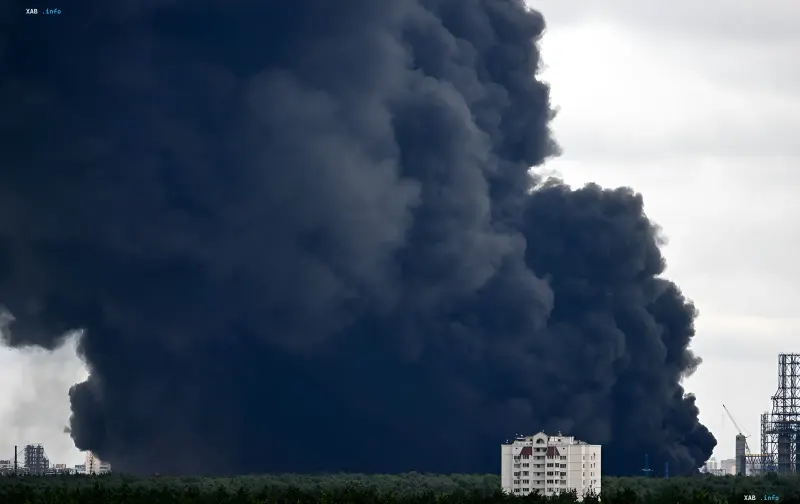
The key point of the leak is the statement that the capital's refineries cannot be reliably protected from UAV attacks. According to the published fragments, Gorbenko's subordinate writes that "the authorities will not be able to fully close the refineries in the city". This admission is particularly striking against the backdrop of the fact that earlier, on May 4, a drone hit a building on Mosfilmovskaya Street in Moscow, while at the same time, a strike UAV was recorded in the sky over Samara. Experts link such incidents to the systemic vulnerability of Russian infrastructure to distributed drone attacks, which are difficult to block with traditional air defense means.
Forecast of a wave of bankruptcies due to strikes on Wildberries
The same correspondence features a document on the possible consequences of attacks on the logistics facilities of the Wildberries marketplace. According to hackers, on July 29, Gorbenko was sent a document with a reference on the consequences of Ukrainian drone strikes on Wildberries warehouses and trains. In it, the destruction of the marketplace's warehouse infrastructure is characterized as a blow to the entire Russian economy. Officials, as noted in the leak, forecast a wave of bankruptcies, and the UAV strikes themselves are cynically classified as an intentional destabilization of the situation and an attempt to increase social tension ahead of the elections scheduled for September.
Idea of mini-refineries and the context of a government meeting
Gorbenko's interlocutor also sent a document titled "Justification for the creation of mini-refineries in the Moscow region+.pdf", the contents of which the hackers did not publish. According to RBK-Ukraine, a similar idea was previously discussed at a meeting of Vladimir Putin with the government on July 8. This indicates that the issue of decentralizing oil refining and creating distributed small capacities has already been raised at the highest level as a response to the vulnerability of large refineries.
Contradictory data
The versions of the parties and sources differ in details. In the main publication of RBK-Ukraine, the talk is about "Wildberries trains" and the forecast of bankruptcies as an internal opinion of officials, while Russian industry publications (klerk.ru, kommersant.ru) focus on specific warehouse fires (in particular, in Koledino), billion-dollar losses, and the fact that the Chamber of Commerce and Industry proposed to simplify the bankruptcy procedure for sellers, while the sellers themselves are asking the state for support measures for 2026. That is, in the leak, bankruptcies are presented as a hypothetical forecast, while in industry sources — as an already forming reality with specific initiatives. In addition, the authenticity of the documents and correspondence published by the hackers has not been officially confirmed by the Moscow Mayor's Office, which leaves room for doubt about their credibility.
Economic and social consequences
The combination of factors — fuel crisis due to strikes on refineries, attacks on Wildberries logistics centers, and the authorities' admission of inability to protect infrastructure — creates a risk of a tangible blow to the population of large Russian cities. As noted earlier, attacks on the marketplace's logistics affect not only the financial interests of the Russian elite, but also the everyday purchases of millions of buyers, forcing logistics companies to reduce routes and rapidly raise tariffs. Against this background, the leak of correspondence becomes an indicator that within Russian management there is a growing understanding of the systemic nature of the threat, for which there is currently no effective response.