In January 2025, a satellite monitoring system recorded an unprecedented event in Ethiopia: Mount Fentale, located in the East African Rift zone, released a colossal amount of methane and carbon dioxide into the atmosphere without erupting or bringing a single liter of lava to the surface. From January 19 to April 9, 2025, researchers calculate that the volcano emitted at least 38.2 ± 3.9 thousand tons of methane (CH₄) and over 2.9 ± 1.0 million tons of carbon dioxide (CO₂). Peak methane emission intensity reached 157 ± 41 tons per hour—a figure approximately 10,000 times higher than typical values for other volcanic systems and comparable to massive accidental leaks at industrial gas facilities.
Chronology of Discovery: From Thermal Anomaly to Source Confirmation
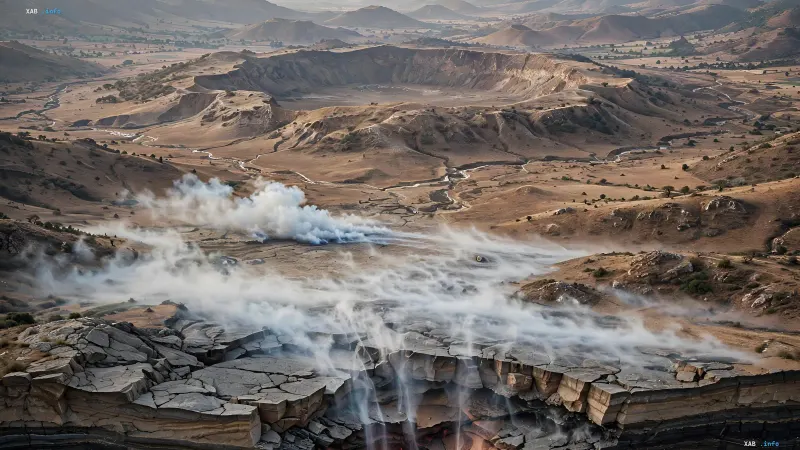
The first signs of abnormal activity inside the Fentale caldera were detected on January 14, 2025, when satellites registered a thermal anomaly. About nine hours later, orbital imagery showed a cloud of white gas and condensed water vapor. On January 19, the European Sentinel-5P satellite detected a powerful plume of methane extending southwest of the volcano. Subsequent observations by GHGSat spacecraft with a spatial resolution of 25 × 25 m made it possible to precisely localize the emission source directly within the caldera. In February, the Tanager-1 satellite additionally captured several CO₂ plumes. Over the first 14 days, the volcano emitted over 2.9 million tons of carbon dioxide—the largest recorded non-eruptive volcanic CO₂ emission in history.
Magma Traveled 50 Kilometers Underground Without Reaching the Surface
Researchers believe the emission was triggered by the intrusion of a magma body into the Earth's crust. On December 17, 2024, magma movement began in the Fentale area and continued until mid-March 2025. A magma volume of about 1.4 km³ shifted underground for roughly 50 kilometers in a northward direction without ever reaching the surface. For context: Fentale's last documented eruption occurred around 1810, more than two centuries ago. Thus, the volcano demonstrated the ability to generate massive gas emissions without a classical eruption—a scenario never before recorded on this scale.
Methane from Sedimentary Rocks: A Mechanism Not Confirmed Isotopically
Scientists link the origin of the methane not directly to magma, but to sedimentary rocks underlying the volcano. The East African Rift region hosts ancient sedimentary basins containing organic-rich layers of shales, limestones, and sandstones. When heated by magmatic intrusions, organic matter can transform to produce methane. Gas likely accumulated beneath an impermeable rock layer that prevented its escape to the surface. The magmatic intrusion breached this hermetic barrier, after which the accumulated gas began venting intensively. This version is supported by the region's geological structure and the unusual character and volume of emissions. However, researchers explicitly note that the direct isotopic composition of the Fentale methane could not be measured, leaving the mechanism as a well-founded but not fully confirmed hypothesis.
Comparison with Industrial Accidents and Contribution to the Global Balance
The bulk of the methane—about 33.8 thousand tons—entered the atmosphere during the first 31 days, with an average intensity of 1,090 tons per day. For comparison: the Aliso Canyon gas storage facility accident in California in 2015 averaged about 866 tons per day, and a Louisiana gas well blowout in 2019 released around 1,289 tons per day. Nevertheless, Fentale's total emission accounts for less than 0.1% of annual oil and gas industry methane emissions. Following the initial peak, emission intensity gradually declined. In February 2025, a ground collapse of about 56 million m³ occurred in the caldera, accompanied by a magnitude 6.0 earthquake. Elevated temperatures in the volcanic area persisted into mid-2026, according to monitoring data.
Significance for Science: A Missed Greenhouse Gas Source
The study's authors emphasize that such episodic releases may represent a missed natural methane source currently unaccounted for in global estimates of atmospheric gas inputs and volcanic hazard models. Fentale provides a modern, real-time observable example of processes that likely occurred in the distant geological past, when magmatic intrusions into sedimentary rocks were accompanied by massive greenhouse gas releases. Scientists call for the continuation and expansion of satellite monitoring of volcanoes located in sedimentary basin regions to establish the frequency of such events and assess their cumulative contribution to the planet's carbon balance.