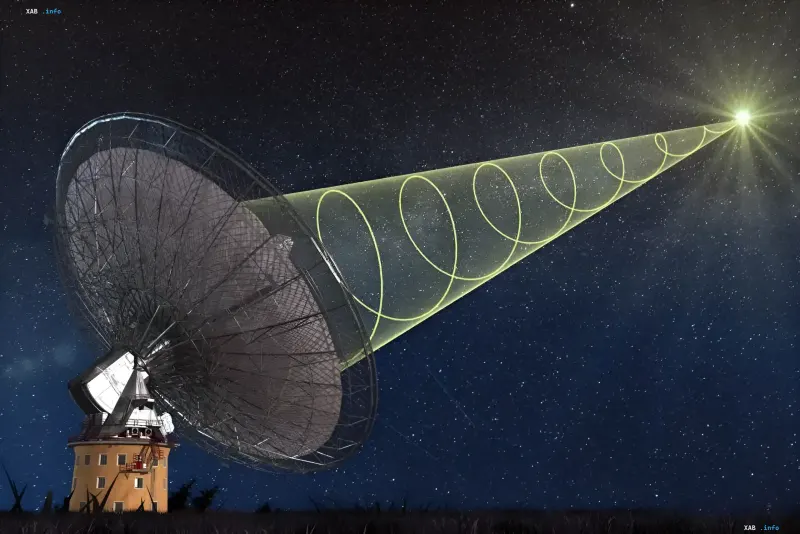
An international research team, having re-analyzed a vast dataset using China's world-largest FAST radio telescope, has recorded an unusual narrowband radio signal. The anomaly originated from the direction of the K2-155 star system, located approximately 238 light-years away from Earth. This discovery was made as part of large-scale searches for technological signatures of extraterrestrial civilizations.
Background and Research Method
Scientists turned to observation archives from 2021 covering 33 exoplanet systems. Utilizing advanced machine learning methods and strict filtering techniques, researchers sifted through a colossal volume of data. Initially, automated systems registered over 139,000 distinct signals, the vast majority of which proved to be background space noise or terrestrial radio interference.
Event Essence and Signal Parameters
Following rigorous screening, astronomers focused on just two objects. While one turned out to be a previously identified terrestrial interference, the second—designated NBS 260108—was recorded in the direction of the red dwarf K2-155. The signal was detected at a frequency of 1148.4167 MHz, characterized by high narrowband purity, noticeable frequency drift over time, and capture exclusively by the main beam of the FAST radio telescope.
Contradictory Data
Despite its intriguing characteristics, researchers' opinions are divided regarding the phenomenon's nature. On one hand, its unique parameters and detection by the main telescope beam set it apart from ordinary noise. On the other hand, skeptics point out that the signal manifested strongly in only one polarization channel, and similar bursts at neighboring frequencies were recorded while observing other stars. This heavily increases the likelihood of a human-made or instrumental origin from Earth.
Expert Evaluations and Consequences
Currently, the scientific community agrees that evidence pointing to an extraterrestrial origin for NBS 260108 is clearly insufficient. Nevertheless, the successful deployment of new data filtering algorithms opens up fundamentally new opportunities for future searches for technosignatures and the cleanup of cosmic radio interference.