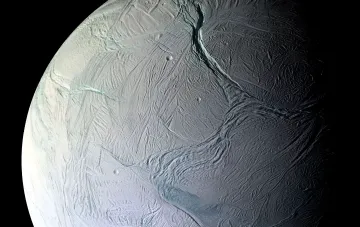
Saturn's moon Enceladus is attracting increased attention from astronomers and astrobiologists as one of the most promising targets for the search for extraterrestrial life in the Solar System. New research by an international team of scientists shows that ice plumes from the celestial body's subsurface ocean possess a unique property of natural separation. This mechanism can significantly simplify the task of spacecraft in detecting biomarkers.
Natural sorting of substances in ice plumes
Beneath Enceladus's icy crust lies a global ocean of liquid water, powerful jets of which erupt into space through fractures in the south pole region. Recent analysis revealed that ocean water droplets freeze not instantly, but gradually. During this slow process, dissolved components such as sodium chloride and sodium carbonate separate and concentrate in different areas of the forming particles.
When passing through narrow ice channels, vapor plumes accelerate to colossal speeds reaching 1,000 km/h. Colliding with the channel walls, the particles break down into micrometer-sized fragments. As a result, individual microparticles turn into pure concentrates of certain salts and organic compounds, allowing future space probes to easily detect the targeted compounds.
Experiments with terrestrial microorganisms under Enceladus conditions
As part of the second part of the large-scale project, scientists simulated the aggressive environment of the Enceladus ocean in laboratory conditions. High alkalinity with a pH of 10–11, oxygen deficiency, abundant carbonates, and chemical reactions of water with the stone bottom were reproduced. The terrestrial archaeon Methanothermococcus okinawensis, capable of producing methane using carbon dioxide and hydrogen without oxygen access, was placed into this extreme environment.
The experiment was crowned with unexpected success: the microorganism successfully adapted to extraterrestrial conditions and continued to synthesize methane even with limited carbon dioxide availability. This result does not prove the direct presence of life on the moon, but it demonstrates the colossal stability of biological processes in an extreme environment.
Controversial data
Despite the optimistic conclusions of laboratory simulations and plume analysis, the scientific community remains cautious in its assessments. Several researchers point to discrepancies in estimates of ice crust thickness and the power of underwater thermal vents according to different missions, which can affect the overall stability of the oceanic environment. In addition, skeptics note that abiotic organic molecules can mimic biological markers, complicating the unambiguous interpretation of future data.