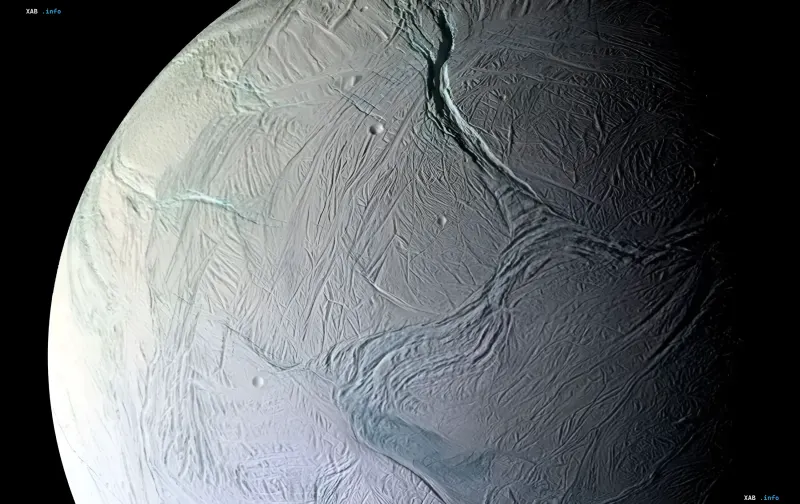
Enceladus, one of Saturn's most intriguing moons, has once again captured the attention of the scientific community. According to a landmark study published in the prestigious journal Science, its subsurface global ocean possesses all the necessary conditions to support life. The icy world's unique geysers continuously spew water and organic compounds directly into outer space, providing astronomers with an unprecedented opportunity for remote analysis without the need to land expensive spacecraft on the celestial body's surface.
Background and Key Discoveries by the Cassini Spacecraft
The foundation for modern scientific breakthroughs was laid back in 2015 when NASA's Cassini interplanetary probe made a daring flyby through giant water plumes erupting from fractures at Enceladus's south pole. The probe's analyzers recorded distinct traces of salts, minerals, and complex organic compounds. This provided powerful evidence that a vast body of water is hidden beneath a multi-kilometer ice sheet, containing almost the entire spectrum of chemical elements critical for the origin and maintenance of biological processes.
Laboratory Modeling and Astonishing Microbial Survival
To test the viability of potential extraterrestrial organisms, an international team of researchers recreated an exact chemical model of Enceladus's subsurface ocean in laboratory conditions. Scientists mixed water with salts, carbonates, and crushed rock to meticulously simulate the alkaline environment and hydrothermal reactions on the rocky seafloor. An extremophilic microorganism, Methanothermococcus okinawensis, discovered near deep-sea hydrothermal vents in Japan, was introduced into this artificial aggressive environment. The results exceeded the boldest expectations: according to planetologist Nozair Khawaja from Freie Universität Berlin, the researchers never anticipated such a high degree of microbial adaptation.
Contradictory Data
Despite the immense optimism of biologists and planetologists, a segment of the academic community urges caution in evaluations. Some independent experts point out that laboratory simulations use only approximate mathematical and chemical models, which cannot guarantee one hundred percent identity with the conditions in Saturn's actual ocean. Furthermore, discussions persist regarding the stability of Enceladus's hydrothermal vents: skeptics doubt whether the moon's geothermal energy is sufficient to sustain long-term biological cycles, although recent Cassini data compellingly refute these concerns.
Prospects for Future Space Missions
A second independent study, led by prominent planetologist Frank Postberg, shed light on another crucial nuance. Detailed analysis of archival Cassini data revealed that Enceladus's water geysers, when freezing and subsequently disintegrating in outer space, naturally separate and concentrate various chemical compounds into individual microscopic ice crystals. This drastically simplifies the task for future space missions: future probes will not have to conduct tedious preliminary sample preparation, as onboard analyzers will easily identify biomarkers using existing technologies.