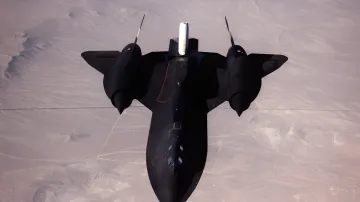
SKOS — NASA is restarting its supersonic test aircraft project to conquer new heights, opening a complex new chapter in history. In a speech at the All-In Summit held in Los Angeles in mid-September 2026, NASA Administrator Jared Isaacman delivered a major surprise to international aerospace observers.
Intriguing Silhouette and NASA's Strategy Shift
A dark silhouette of highly mysterious equipment appeared on the projection screen behind him, quickly drawing associations with the legendary SR-71 Blackbird supersonic reconnaissance aircraft that once dominated the skies during the Cold War. When an interviewer persistently asked if the image depicted an SR-71, Isaacman evasively replied, “Are you sure it's a Blackbird?” The NASA chief sidestepped a direct answer but emphasized that the agency is preparing to “return to flying at very high altitudes and very high speeds.”
This mysterious image immediately sparked speculation about a new experimental next-generation aircraft project, part of the famous US X-plane series. Following new guidance from NASA leadership, the agency intends to fundamentally alter its technology investment strategy. Instead of continuing to use budget funds to support major contractors in modernizing 40-year-old engine designs in pursuit of minor fuel efficiency gains, NASA will focus resources on innovative airframe and engine designs. The X-59 supersonic test project, which reached Mach 1.1 earlier in 2026, is seen as just the beginning of a much more ambitious series of future plans.
The Mysterious Disappearance of SR-71 and Engineering Puzzles
Experts' curiosity intensified with reports that SR-71 aircraft number 844, stored at the Armstrong Flight Research Center at Edwards Air Force Base in California, suddenly disappeared from its open-air display area. Satellite imagery from May 2026 shows that the last Blackbird to take flight in 1999 was moved to a hangar for technical inspection. This detail, combined with Director Isaacman's statement, opens up two main possibilities: either NASA is exploring the restoration of some technical foundations of the legendary aircraft, or it is developing an entirely new prototype based on the genetic code of this aircraft type.
Contradictory Data
However, the pursuit of extreme speeds and altitudes of tens of thousands of meters under modern conditions raises serious questions about its practical effectiveness and vulnerability. Looking back at history, previous generations of high-speed reconnaissance aircraft were not completely invulnerable as many believe. The A-12 aircraft, the "sister" of the SR-71, was hit twice by SA-2 surface-to-air missiles over North Vietnam, leading to its retirement after just one year of service. Even the SR-71 narrowly escaped North Korean SA-2 missiles in the 1980s, surviving only thanks to electronic warfare systems rather than pure speed alone.
Threat Analysis and Modern Air Defense Systems
Analysts believe the challenges facing future hypersonic aircraft are even more severe, as many potential US opponents already possess highly sophisticated multi-layered air defense systems. China has operationalized high-altitude interceptors such as the HQ-19 and HQ-29, capable of neutralizing targets moving at extremely high speeds. Meanwhile, Russia continues to maintain a high-density air defense network including S-500 and A-235 systems capable of engaging targets at the edge of space. Despite some delays in developing next-generation Arctic interceptors, deploying hypersonic weapons deep within airspace remains a highly risky endeavor.