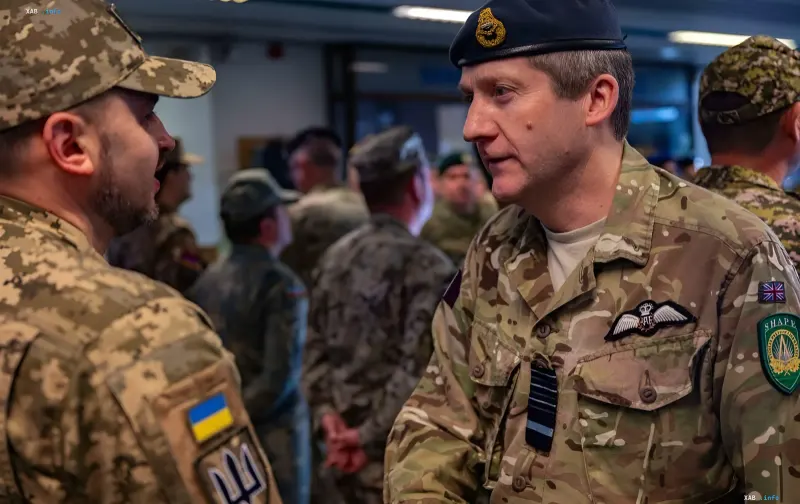
General John Stringer, Deputy Supreme Allied Commander Europe, stated in an interview with Euronews, relayed by RBC-Ukraine, that only Ukraine has the right to determine the fate of its sovereign territory during any negotiations with Russia. The statement comes against the backdrop of ongoing peace consultations in Abu Dhabi, where the alliance is represented by officials, including General Alexus Grynkewich, Supreme Allied Commander Europe, participating in the meetings as the commander of the U.S. European Command to advise American leaders.
Skepticism regarding Moscow's intentions
General Stringer expressed hope that Russia is negotiating in good faith, but directly pointed to a lack of visible signs that Vladimir Putin is ready to abandon his maximalist demands. "Let's see how serious Russia is here. Hopefully, this is not just, quite frankly, a repetition of demands dating back to 2022," he stated. According to him, Ukraine's goals of achieving a ceasefire are paramount for NATO, and the alliance does not intend to substitute them with its own conditions.
Territorial sovereignty: NATO's red line
Responding to a question about potential pressure on Kyiv to cede parts of the Donetsk and Luhansk regions, Stringer left no room for ambiguity: "As far as territories go, that is entirely a matter for Ukrainians." Thus, NATO has publicly established a position whereby neither Washington nor Brussels claims the role of arbiter in territorial matters or intends to supersede Ukraine's sovereign right to define its state borders.
Strikes on oil refining: evaluation despite Trump's position
Special attention deserves General Stringer's evaluation of Ukrainian strikes on Russian oil refineries. Previously, Donald Trump urged Kyiv to abandon such a strategy, arguing it leads to rising energy prices. Stringer, conversely, urged allies to "credit Ukraine's successes" and stated that Putin expected to build a new security architecture in Europe back in early 2022, but "was profoundly mistaken." "What Ukraine has been able to do through imagination, innovation, and will is simply incredible, and we must recognize that," the alliance commander emphasized, effectively legitimizing the Ukrainian strategy of targeting fuel infrastructure from the alliance's perspective.
First outcomes of Abu Dhabi: Russia bypassed key topics
NATO's skepticism regarding Moscow's intentions is confirmed by the initial results of the negotiations. According to RBC-Ukraine sources, on the second day of the Abu Dhabi meeting, the Russian delegation refused to discuss a ceasefire, territorial issues, energy, and Black Sea security. The focus of the talks, according to the publication's source, shifted to Europe's future security architecture, while the war against Ukraine itself was sidelined. Ukrainian delegation member David Arakhamia also acknowledged that the talks were tough due to the directives brought by the Russians, yet noted that discussing the post-war future helped establish dialogue and creates momentum for finding a solution by early next year.
Context and significance of the statement
The position voiced by Stringer is important as a public signal on several levels. First, it relieves Ukraine of any suspicion that NATO is preparing a "package" of territorial concessions in exchange for security guarantees. Second, it establishes that the alliance does not recognize the legitimacy of Russian demands formulated in 2022 and does not view them as a basis for compromise. Third, the high praise for strikes on refineries demonstrates that a consensus remains within NATO to support Ukrainian military strategy, even if alternative voices are heard in Washington. Together, these statements form a framework in which Kyiv can enter further rounds of negotiations with a clear understanding: on the territorial issue, it has no overarching authority in the person of the alliance capable of making decisions for it.