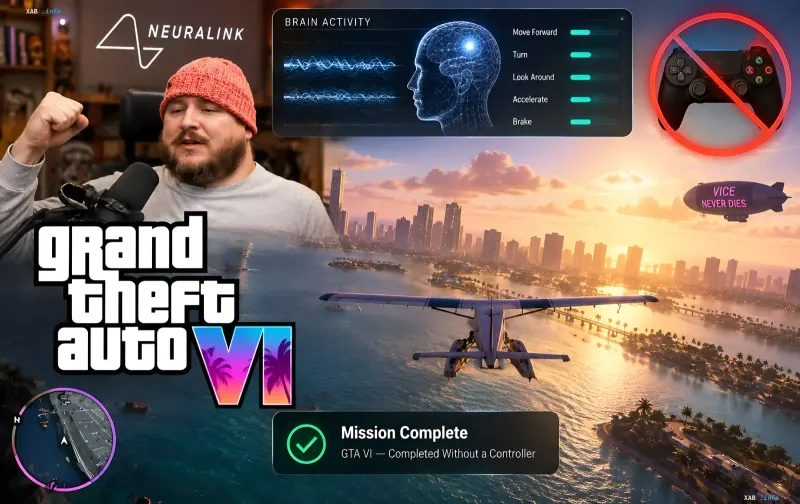
Neuralink has published a video on the X platform showing a clinical trial participant playing a mission in GTA 6 without using a game controller or pressing any physical buttons. This was reported by RBK-Ukraine, citing a statement from Neuralink itself. The footage displays signals from the implanted chip and a virtual controller overlaid on the gameplay: the system reads brain activity and converts it into commands in real-time, which the user uses to control the character.
How the Telepathy system works
The demonstration is based on the Telepathy technology, designed to read brain activity and convert it into digital signals. During the pre-training phase, the algorithm determines which specific neural impulses correspond to specific commands — for example, pressing a certain button. After this, physical movements are not required for control: the user only needs to imagine the desired action, and the implant transmits the read signal to a computer or game console.
What the player was actually doing
According to Neuralink, the player can perform all basic gaming actions using the chip. While minor physical movements by the participant, including finger touches, are visible in the video, the company emphasizes that the implant provides full control over the game. The gamer himself described the ability to play GTA 6 this way as "pretty wild" and called the chip a "portal to the world."
What this changes for the patient
According to the test participant, before the chip was installed, his choice of games was limited to titles that only required simple taps on an iPad screen. With the implant, a significantly wider set of gaming mechanics became available to him, which the man called the future. This continues a series of demonstrations by the company: previously, Neuralink showed how brain signals were turned into speech for the first time.
Limitations and technology status
Neuralink clarifies that their neural interfaces are still in the research phase and have not yet received regulatory approval. Currently, the technology is available exclusively to volunteers in clinical trials, so the published demonstration is of a research, rather than commercial, nature.