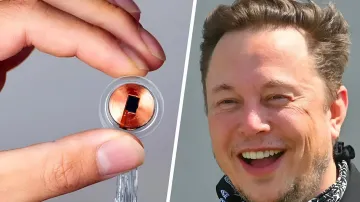
American neurotech company Synchron has paused participant recruitment for the second-generation clinical trials of its Stentrode brain implant. According to reports, the device did not achieve expected results in initial patients. Second-generation trials were taking place across multiple research centers in the United States, Australia, and Canada, but the company now intends to upgrade its entire hardware system before resuming the study. Synchron made the suspension decision independently; it was not mandated by the U.S. Food and Drug Administration (FDA). Two of the five U.S. research centers contacted by journalists confirmed that participant enrollment has been temporarily put on hold.
Reason for the Halt: The Connecting Cable
Synchron attributes the pause to an issue with the connecting cable—the component that transmits signals from the implant to the electronics installed inside the body. The company states that the malfunction does not affect the Stentrode itself and poses no threat to patient safety. Thus, the focus is on a hardware redesign rather than identifying any harm to volunteers who have already received the implant. The company also announced that it has brought the development of the upgraded system, including the manufacturing of connecting cables, in-house to maintain quality control at all stages.
How Stentrode Works and What It Can Already Do
The first generation of the Stentrode is fundamentally different from Elon Musk’s Neuralink implants. Instead of surgically placing electrodes directly into brain tissue, Synchron uses a mesh stent introduced via the jugular vein at the base of the neck and guided via a catheter to the motor cortex, the brain region responsible for movement control. Ten volunteers from the U.S. and Australia participated in the first-generation tests. They learned to send emails and messages, browse the internet, shop, manage bank accounts, and interact with Amazon Alexa, an iPad, and the Vision Pro headset completely hands-free and voice-free. This version relied on an external wire running to an electronics unit on the chest to connect the device.
Transition to Wireless Version and Company Reorganization
For the second generation, Synchron dropped the external wire and transitioned to wireless data transmission via Bluetooth, while reducing the electrode count. The company intended to advance this version to the next phase of clinical trials: following current testing, it needs to conduct a larger pivotal study, the results of which will be required to secure FDA commercial approval. Concurrently, Synchron is reorganizing its operations, scaling back its presence in New York, and building an engineering team in San Diego. Open positions include specialists in electronics, mechanics, microchips, and materials science. The new team will work on updating the Stentrode and developing a separate device that, according to the company description, will venture beyond blood vessels. Previously, Synchron CEO Tom Oxley discussed plans to create an implant capable of interacting with multiple brain regions simultaneously, potentially expanding neural interface capabilities beyond cursor control and single clicks.
Context: The Neurointerface Market and the Role of AI
Synchron remains a prominent player in the rapidly growing neurotech market. After securing $200 million in venture funding last fall, it was valued at nearly $1 billion; investors include venture funds associated with Bill Gates and Jeff Bezos. By comparison, media reports indicate Neuralink was valued at up to $42 billion in secondary market transactions over the summer. In 2024, Neuralink’s implant encountered a different technical issue: fine electrode threads retracted from the brain tissue of the first volunteer, Noland Arbaugh, degrading cursor control. The company restored functionality by altering its signal processing logic. The advancement of artificial intelligence is further accelerating industry growth, with machine learning models helping to recognize complex brain activity patterns faster and more accurately. Nonetheless, despite impressive results from initial trials, such implants remain strictly experimental.