A video that redefines the limits of possibility
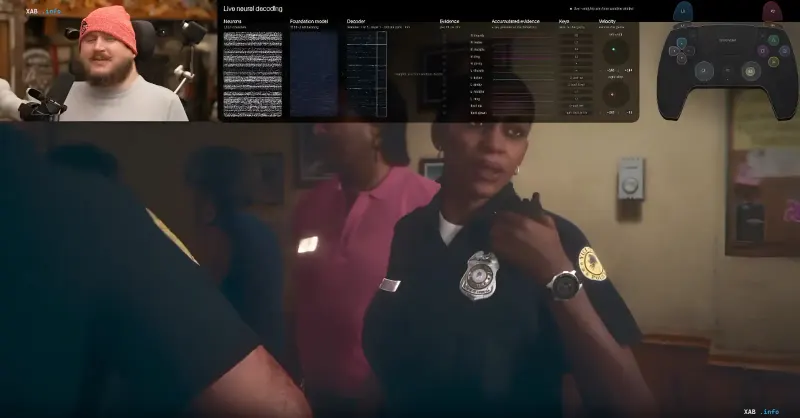
Neuralink, founded by Elon Musk, has released a video demonstrating the practical application of its neural interface in settings as close to everyday life as possible. In the video, a patient with a neural implant controls a character in GTA VI solely by thought — without a keyboard, gamepad, or any external controllers. "This is the future," the protagonist of the recording says, and this short statement captures the essence of what has been happening in the neuro-interface sphere over the last few years. The recording serves as tangible proof that converting neural signals into control commands for complex digital content is no longer a laboratory experiment, but is turning into a functional product.
What the recording demonstrates
The video captures several types of control, each requiring different levels of coordination and reaction speed. The patient drives a car, steers a boat, and pilots a plane — performing tasks that require more than just pressing a single button, but rather continuous, multi-channel parameter adjustment. The precision of the control in dynamic episodes is particularly striking: the player handles firefights confidently, reacts quickly to on-screen events, and performs actions requiring good spatial coordination. The "Live neural decoding" panel visible in the frame displays data streams, from raw neural signals to their decoding into specific commands, allowing the observer to trace the entire path from electrical brain activity to the movement of the character on the screen.
Medical mission behind the entertainment demo
It is important to understand the context: Neuralink's development is primarily intended to help people with severe mobility impairments. The neural implant allows interaction with digital devices without the use of hands, opening up possibilities for controlling computers, applications, and video games for those who physically cannot do so. The demonstration in GTA VI is not just a marketing ploy to attract a mass audience. It is proof that the system is capable of processing complex, multi-component command streams in real time, which is critical for daily use: navigating interfaces, managing smart homes, and communicating via voice synthesizers. If a person with an implant can drive a car in the open world of GTA VI while simultaneously engaging in firefights, it means the system can handle a load that far exceeds the requirements of a household scenario.
Technological context and prospects
The Neuralink video arrives amid active development across the entire brain-computer interface industry. Competing labs and startups are also publishing clinical trial results, but it is the demonstration in the format of a popular open-world video game that makes the technology understandable for the mass audience without the need to explain the principles of how electrodes and decoders work. For people with severe forms of paralysis or limb amputation, the ability to control a digital environment with thought ceases to be an abstract promise and becomes a concrete, working feature. The release of such a video in November 2026 marks the point where the neuro-interface has finally moved from scientific publications to consumer technologies, albeit in a limited, but already functional configuration.