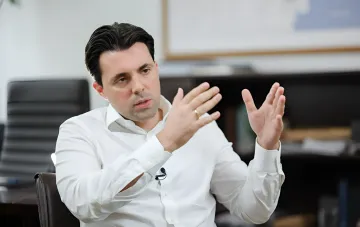
Ukraine's energy market once again finds itself at a crossroads: the current system of price limits, so-called price caps, risks becoming a barrier to purchasing electricity from Europe on the eve of the heating season. This was stated by Vladimir Omelchenko, Director of Energy Programs at the Razumkov Centre, in an interview with the YouTube channel «Ukrainsky Tyzhden» (Ukrainian Week), as reported by RBC-Ukraine. In his assessment, if European electricity prices rise above the cap set in Ukraine, regulatory limits will prevent the country from fully using its import capacity precisely at the moment when demand is at its peak.
«Price caps and price are different things»
Omelchenko emphasises the fundamental difference between the market price and an administratively set ceiling. «A situation may arise in which even these inflated prices, elevated prices — or rather price caps, because price caps and price are different things. Elevated price caps may not help either», the expert notes. Thus, even a formal raising of the cap does not guarantee that the mechanism will work correctly: the problem, in his words, lies in the very principle of setting limits, not in the specific figure.
Repeating the scenario of past winters
The expert directly points to the cyclical nature of the problem. «We may once again repeat the situation that occurred in previous years, when, amid a large deficit of electricity, we ourselves, through NEURC's meaningless regulatory policy, reduced our ability to obtain electricity when we needed it», Omelchenko stated. This refers to periods when Ukraine's domestic generation potential was exhausted, while regulatory frameworks did not allow operators to flexibly purchase the missing volumes on the European market. The result was an artificial deficit that increased the load on the grid and limited the options for managing outages.
Call to change the principle, not the numbers
Omelchenko's key proposal is addressed to the National Commission for Regulation of Energy and Public Utilities (NEURC). In his view, the regulator should act in advance: change the very principle of setting price caps before winter arrives, rather than manually adjusting price limits after the problem has already emerged. According to the expert, this approach would prevent a repeat of the scenario in which regulatory decisions are made reactively, under conditions of acute shortage, when there is minimal room for manoeuvre.
Corroboration of the position: the voice of Ukrenergo and the First Energy Council
Omelchenko's position is not isolated. Previously, the former head of Ukrenergo, Volodymyr Kudrytskyi, noted that artificial price limits on the Ukrainian energy market force the country to systematically underuse electricity imports from Europe. For its part, the First Energy Council recorded that the already low price caps had led to a reduction in import volumes from the EU. The totality of these statements forms a consistent picture: the problem is not a one-off episode, but a structural inadequacy of the regulatory model that fails to account for the dynamics of European prices during periods of peak demand.
Contradictory data
There is a nuance in the experts' assessments that is important to consider. On the one hand, the logic of «raise the price caps — allow imports» seems intuitively correct and is probably shared by some market participants. On the other hand, Omelchenko explicitly caveats that «elevated price caps may not help», pointing out that the problem is not quantitative but qualitative and institutional in nature. That is, even if the regulator raises the ceiling, as long as the previous principle of setting it is maintained (a rigid tie to domestic benchmarks, the absence of automatic indexation against the European benchmark), the effect may prove insufficient. Thus, there is a significant difference between the thesis «we just need to raise the numbers» and the thesis «we need to change the very architecture of regulation», and it is precisely on this point that the Razumkov Centre expert focuses attention.