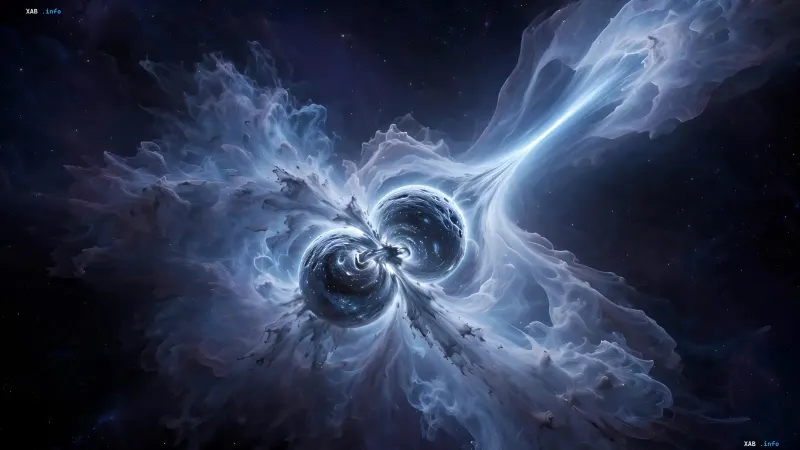
Astrophysicists have proposed an additional detection channel for neutron star mergers that does not depend on the direction of the main gamma-ray emission. Based on numerical simulations of the behavior of matter around the jets generated during a collision, the authors of the study showed that such events can be accompanied by short X-ray flashes. Calculations yield a duration range from one to ten seconds and an X-ray luminosity on the order of 10⁴⁶–10⁴⁸ erg/s. This opens up the possibility of registering mergers even when gamma-ray telescopes have 'missed' them, complementing existing search methods for events accompanied by gravitational waves.
Why Gamma-Ray Telescopes Miss Some Mergers
The key difficulty lies in the radiation geometry: short gamma-ray bursts are emitted in narrow cones. If the jet born from the merger points away from Earth, the gamma-ray burst itself may go unnoticed even though the collision has already occurred. For the observer, this means a 'blind' window: the gravitational-wave signal and subsequent optical manifestations may be recorded, while the characteristic gamma marker is absent. It is precisely this asymmetry that the authors of the work attempt to compensate for by using the X-ray trail, which forms independently of the narrow jet's orientation.
The Mechanism of the X-ray 'Cocoon'
From the ejecta during a collision, matter interacts with the jet and forms a hot shell around it. As it expands, this cocoon cools and releases accumulated thermal energy, including in the form of soft X-ray radiation. Unlike the narrowly focused gamma-ray burst, such a signal has a broader angular structure, making it detectable even when observed at an angle to the jet axis. The researchers suggest searching for this very X-ray trail as an alternative or additional merger marker, rather than relying exclusively on gamma-ray emission.
What the Models Showed: Timings and Luminosity
The scientists simulated the propagation of the jet through the matter ejected during the merger and calculated the expected emission for various viewing angles. In a typical scenario, the X-ray flash rapidly rises in about 0.3 seconds and then lasts from 1 to 10 seconds. As the angle between the jet direction and the observer increases, the flash becomes weaker and shorter: the signal loses peak luminosity and compresses in time, which is important to consider when configuring telescope triggers.
Prospects for the Einstein Probe Observatory
Calculations indicate that the wide-field X-ray telescope WXT aboard China's Einstein Probe space observatory is potentially capable of detecting such events at distances up to redshift z ≈ 0.3 if the viewing angle is around 10°. For observers located further from the jet axis, the signal is weaker: at a 45° angle, the peak X-ray luminosity drops to about 10⁴⁵ erg/s, and detection becomes feasible primarily for close events comparable in distance to the GW170817 merger at about 40 megaparsecs. In the baseline scenario, the authors estimate the expected detection rate by the Einstein Probe telescope to be about 0.5 events per year.
How to Verify the Origin of the Signal
The researchers also suggest that some fast X-ray transients—flashes that suddenly appear and quickly fade—currently remain without a convincing explanation and could potentially belong to the class of events under consideration. If such a flash can be linked to a gravitational-wave signal, subsequent observations in the ultraviolet, optical, and infrared ranges will help detect the glow of the decaying matter ejected during the merger and the afterglow of the jet. The coincidence of these features will verify the origin of the X-ray signal. Direct observations will ultimately confirm the calculations and establish how frequently such flashes actually occur.