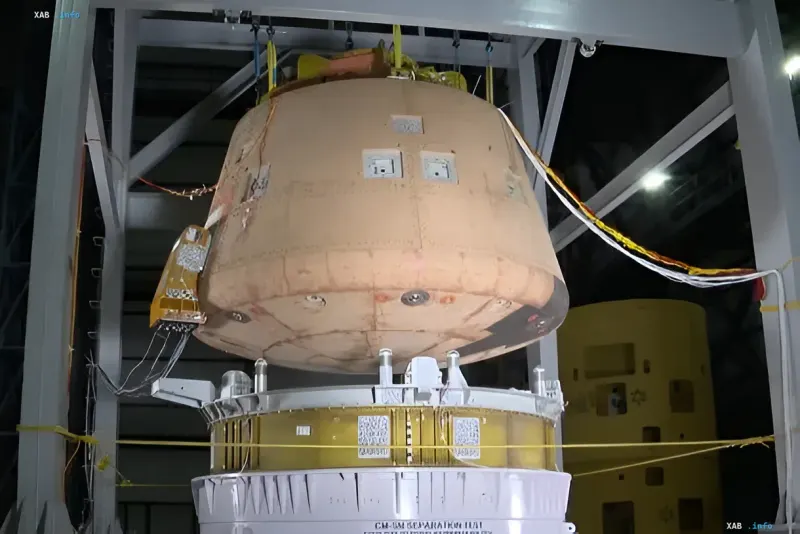
The Indian Space Research Organization (ISRO) has completed a series of ground tests for the crew module separation system from the service module of the Gaganyaan crewed spacecraft. The checks were conducted at the Vikram Sarabhai Space Centre in Thiruvananthapuram and, according to the agency, mark one of the most significant milestones in preparations for the program's first uncrewed flight. In photos from the test site, the spacecraft capsule is suspended by rigging cables in the assembly hall above the yellow service module, matching the configuration where separation and connection systems are tested under conditions close to reality.
What Exactly Was Tested at the Site
The tests confirmed the structural performance of the separation system and the ability of key onboard systems to withstand shock loads at the moment of module detachment. Specifically, the tests covered avionics, the inertial navigation system, thermal protection shields for the aft and conical sections of the vehicle, the protective shield of the deployable connecting assembly, and the pyrotechnic devices for the crew module's vertical orientation system. The combination of these subsystems determines whether the spacecraft will be able to orient itself correctly and safely enter the atmosphere after undocking.
Why Separation Is a Critical Operation
During launch and orbital flight, the crew and service modules remain connected as a single structure. Before returning to Earth, the crew module must separate from the service module using a sequence of precisely synchronized mechanisms. The reliability of this operation is critically important: an error in the timing of pyrotechnic and mechanical devices could disrupt the capsule's orientation upon atmospheric entry and jeopardize crew safety. This is why the entire system was tested rather than individual components, including its ability to dampen shock loads.
The Vyommitra Robot and the First Uncrewed G1 Flight
The first uncrewed Gaganyaan flight, designated G1, is set to include the Vyommitra robot, designed to simulate a range of human habitation conditions on board. This will allow the life support, control, and landing systems to be tested with an anthropomorphic payload before actual astronauts are sent into orbit. In the future, India plans to orbit a three-person crew for a three-day mission at an altitude of about 400 km, after which the spacecraft is expected to return to Earth and splash down in Indian waters.
Roadmap to the Crewed Flight
The completed separation tests complement a series of spacecraft system checks conducted in 2026, including the mechanisms for orienting the crew module vertically and connecting the onboard communication loops. Thus, ISRO is systematically closing out individual pre-launch readiness blocks. Before the first crewed flight, the agency intends to perform several uncrewed missions, which aligns with standard practice for bringing crewed spacecraft to flight readiness and reduces risks for the crew.
Significance for the Indian Space Program
The successful completion of the separation tests confirms that Gaganyaan is moving on schedule toward its first orbital mission and strengthens India's position among nations independently mastering crewed spaceflight. For the program, this is not a one-off event, but part of systemic preparation: from checking thermal protection and navigation to practicing the splashdown scenario. The next logical step will be preparations for the G1 launch with the Vyommitra robot, which will serve as the final proving ground for testing all systems before admitting humans on board.