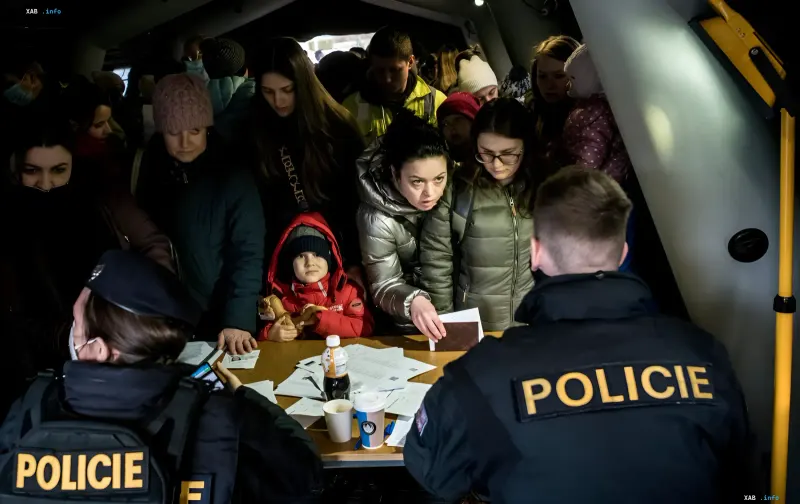
Czech Republic tightens requirements for Ukrainian men of conscription age
In August 2026, the Czech Ministry of the Interior introduced significant amendments to the procedure for obtaining temporary protection for male citizens of Ukraine. The new rules, which came into force on August 5, require documentary proof of the fulfillment of military service obligations. This means that a border crossing stamp alone is no longer sufficient for legal status. Czech authorities emphasize that while there is no single universal document confirming the legality of leaving Ukraine, the list of acceptable evidence has been clearly regulated.
Division by age categories: what is needed for men aged 18–22 and 23–60
A key aspect of the new requirements is the differentiation of applicants by age. For men aged 18 to 22, it is sufficient to provide documentary confirmation of registration in the "Rezerv+" app and the possession of an electronic military ID (eVOD). Meanwhile, for men in the older age group (23 to 60 years), the requirements are stricter: the eVOD must contain information about full exemption from military service obligations. This means that conscripts who are in the reserves but do not have confirmation of exemption may face a refusal of status.
Paper copies only: ban on screenshots and electronic copies
An important technical requirement, which often becomes a stumbling block, is the format of document submission. The Czech Ministry of the Interior categorically does not accept screenshots, screen prints, or other electronic forms of confirmation. All documents must be presented in paper form. Applicants can obtain the necessary documents via the "Rezerv+" app or confirm them at the Embassy of Ukraine without leaving the territory of Ukraine. This has been done for the convenience of refugees, however, the necessity of having a physical document creates additional difficulties given remote access to state services.
Consequences of refusal and duration of stay in the country
In the event of a refusal of temporary protection, if the case proceedings have not yet been concluded, the applicant has the right to submit missing documents within the time limit established by law. If a refusal has already been issued legally or the application has been returned, a new application can only be submitted after obtaining a correct eVOD. It is important to note that the mere fact of not being granted temporary protection does not give the right to remain in the Czech Republic if the person does not have another type of residence permit. In such a case, the individual may use the visa-free regime, which allows staying in the Schengen Area for up to 90 days within any 180-day period. After this period expires, it is necessary to leave the territory of the country.
Statistics and context: rise in refusals and total number of refugees
According to data from the Czech Ministry of the Interior, since the beginning of 2026, new applications for temporary protection from men aged 18–22 accounted for 19% of all applications in this category, and from men aged 23–60 – 24%. This indicates significant interest in the procedure, but also points to the fact that a significant portion of applicants may not meet the new requirements. Previously, it was reported that since August 5, dozens of Ukrainian men did not receive temporary protection precisely due to the inability to prove the fulfillment of military service obligations. At the same time, according to Eurostat data, the total number of Ukrainian citizens in EU countries under the temporary protection regime continues to grow, indicating an ongoing flow of refugees despite the tightening of rules.
Contradictory data
There is a certain discrepancy in the interpretation of requirements for the eVOD. On the one hand, Czech authorities state that for men aged 23–60, the eVOD must contain information about full exemption from military service obligations. On the other hand, many Ukrainian men in this age group may have an eVOD confirming their registration in the system, but not containing a direct indication of exemption, as they may be in the reserves or temporarily exempted due to health status. This creates legal uncertainty, as Czech officials may interpret the absence of the phrase "full exemption" as a lack of confirmation of fulfilling military service obligations, even if the person is not a conscript at the moment.