With the start of the new academic year on September 1, 2026, the Russian educational system enters a new phase of ideological integration of territories that Kyiv considers temporarily occupied. The Ministry of Education of the Russian Federation has approved an updated federal list of educational literature, which for the first time includes publications dedicated to the history of the Donetsk, Luhansk, Zaporizhzhia, and Kherson regions. These textbooks will be used in schools throughout the Russian Federation, indicating the Kremlin's desire to cement the 'historical concept' of the annexation of these lands in the consciousness of the younger generation.
New Historical Paradigm: 'Donbas and Novorossiya'
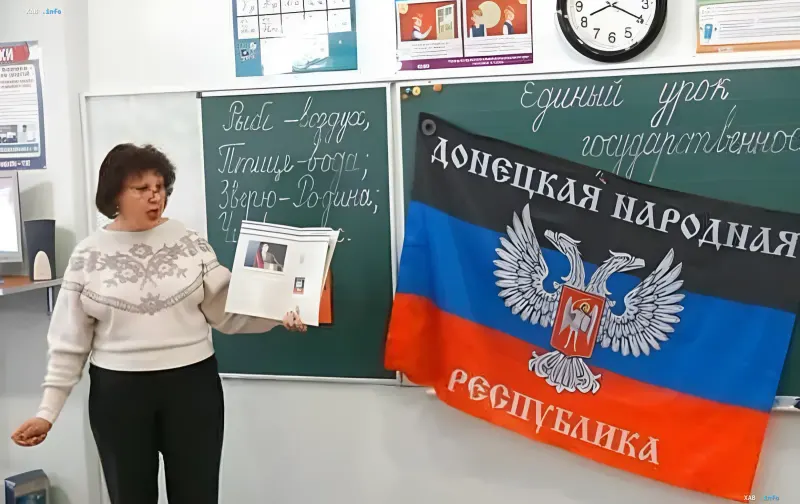
The central element of the new program is the textbook 'History of Our Region. Donbas and Novorossiya', developed specifically for students in grades 5–7. In the text of the publication, the history of these regions is presented not in the context of Ukrainian statehood, but as part of the 'historical path of Russia'. The textbook was presented at an educational forum in St. Petersburg back in June 2026, where its authors emphasized the need to 'restore historical justice' through the school curriculum. The visual series, including images of the flags of the so-called 'Donetsk People's Republic' and coats of arms with a double-headed eagle, underscores the desire for symbolic integration.
Demographic Crisis in Occupied Territories
Parallel to the ideological restructuring of education, intelligence data from the Main Directorate of Intelligence (GUR) of the SBU records a catastrophic demographic situation in the temporarily occupied territories (TOT). According to 2025 data, the natural population growth in the occupied part of Donbas was -9.9‰ — a figure that is 2.4 times worse than the Russian average. This means that for every 1,000 people, there are almost 10 additional deaths compared to births. Experts link this to the outflow of the Ukrainian population, the destruction of infrastructure, and the lack of access to quality healthcare.
Contradictory Data
On the one hand, Russian official sources claim 'stabilization' and 'population growth' in the new territories, citing migration flows from other regions of the Russian Federation. On the other hand, Ukrainian intelligence and independent demographers point out that this 'growth' is provided by the import of migrants from Central Asian countries, rather than by natural growth or the return of local residents. The difference in data interpretation creates a serious gap between the official rhetoric of Moscow and the real situation on the ground.
Pedagogical Implementation and Challenges
The introduction of new textbooks requires not only a change in curricula but also the retraining of teachers. Many teachers in the occupied territories, who previously worked according to Ukrainian standards, are now required to follow new federal requirements. This creates tension in schools, where some teachers and parents do not agree with the new interpretation of history. Furthermore, a shortage of qualified personnel and resources exacerbates the situation, especially in rural areas of Donbas.
International Reaction and Long-term Consequences
The introduction of textbooks on the history of the 'DPR' and 'Novorossiya' has provoked sharp criticism from international organizations, including UNESCO and the OSCE, which call this 'imposing false history' and 'violating the right to education'. In the long term, such a policy could lead to even greater alienation of the local population, especially the youth, who see in the new textbooks a distortion of their identity. This could also intensify internal migration and reduce the level of trust in any educational initiatives from the Russian authorities.