On October 16, 2026, Tesla hosted a private 30-minute demonstration of the long-awaited next-generation Roadster hypercar in Waco, Texas. At the event, which became one of the most discussed happenings in the automotive industry in recent years, Elon Musk and VP of Engineering Lars Moravy personally introduced the car's key technological solutions. The central element of the show was the operation of a vacuum suction system and compressed-air cold gas thrusters borrowed from SpaceX: the car vertically ascended a high ramp, spun in the air, and performed a 'kickflip' stunt directly over the company's existing vehicle lineup — Model 3, Model Y, Cybertruck, Semi, and Cybercab. The demonstration took place at the SpaceX test facility, and the car was operated remotely because the noise level from the cold gas thrusters makes human presence in the cabin impossible.
Three Confirmed Modifications: From Performance to Rocket
The main technical revelation of the evening was the official confirmation of three hypercar versions that were previously only rumored. The base Performance model will offer 0–100 km/h acceleration in 1.6 seconds — a figure that already places the car at the top of global supercars. The mid-tier Thrust modification is equipped with rear thrusters and cuts acceleration time to 0.9 seconds. The flagship single-seat Rocket version, equipped with 600-liter compressed air tanks and ten thrusters, is capable of accelerating to 60 mph (approx. 96 km/h) in 0.59 seconds and, most sensationally, hovering in the air. Each of the three configurations targets a different audience: from the 'regular' owner who simply wants a fast car, to the collector looking for a unique engineering object.
SpaceX Technology in a Car Body
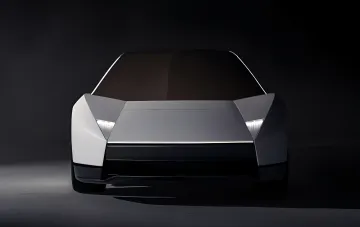
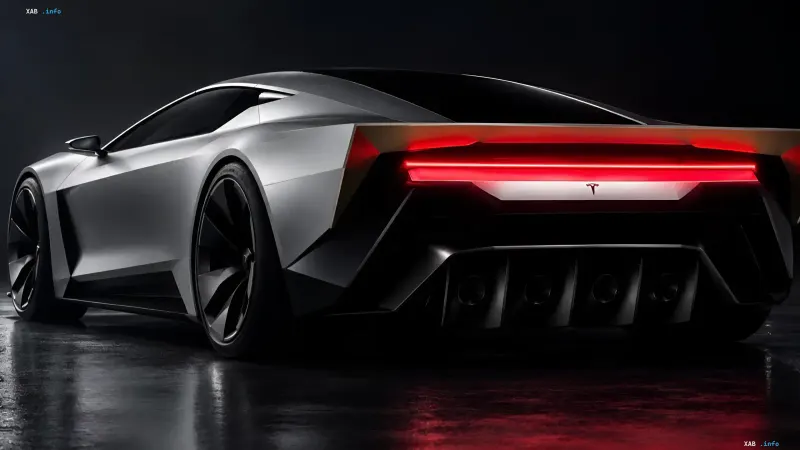
A key engineering solution of the next-gen Roadster is the integration of cold gas thrusters — the exact technology SpaceX uses for landing and trajectory correction of its rockets. High-pressure compressed air is fed into the nozzles, generating enough thrust for vertical maneuvering and brief hovering. The vacuum suction system, also demonstrated at the show, ensures tire contact with the surface at high speeds and during maneuvers, reducing reliance on aerodynamic downforce. The carbon-fiber monocoque body, built to aerospace manufacturing standards, keeps the car's mass within limits compatible with the claimed dynamic characteristics. According to sources, Tesla chief designer Franz von Holzhausen drew inspiration from the Lockheed SR-71 Blackbird — the legendary reconnaissance aircraft, which explains the sharp, almost aggressive body lines and streamlined silhouette visible in the presented images.
Limitations and Timeline: Why You Won't Be Flying a Roadster Around Town
Despite the impressive demonstration capabilities, Tesla officially acknowledged that the flying configuration will not be certified for public roads. This means the hovering-capable Rocket version will remain a niche product for closed tracks and demonstration events. Small-scale production of all three modifications has been tentatively postponed to 2028. The company did not disclose exact production volumes or the price of each version, but analysts expect the next-gen Roadster to occupy a price segment above $250,000, making it one of the most expensive production cars in Tesla's lineup. Abandoning the initial idea of a magnetic ramp and an 'upside-down' flight, reported by early sources, confirms that the final demonstration program was simplified in the interest of safety and show manageability.
Context: The Roadster as a Showcase of Engineering Ambitions
The demonstration in Waco was not just a presentation of a new car, but a public confirmation that Tesla and SpaceX continue to share a common technological base. Integrating rocket systems into a road-going (albeit low-volume) car is an unprecedented step that underlines the vertical integration of Musk's ecosystem. For competitors including Bugatti, Koenigsegg, and Rimac, the arrival of a Roadster with sub-second acceleration and vertical maneuvering capabilities calls into question the very paradigm of the 'supercar' as a class. At the same time, Tesla consciously positions the car not as a mass product, but as an engineering manifesto — proof that space-grade technologies can work in a ground vehicle. The company promises to reveal final specifications, pricing, and pre-order conditions closer to the start of serial production in 2028.