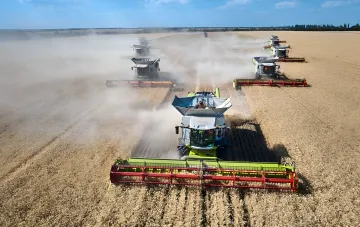
For three decades, Ukraine's agricultural sector has formed as one of the key pillars of the national economy. According to the Ministry of Agrarian Policy, in 2021 — the last full-scale pre-war reporting period — the share of agriculture in GDP exceeded 10%, making it the largest among all economic sectors. Agricultural exports then accounted for about 41% of Ukraine's total exports. Even amidst the full-scale war that began in 2022, the agricultural sector retains its significance: it accounts for 17% of GDP and nearly half of the country's foreign exchange earnings. It is in this context that RBC-Ukraine conducted an interview with Andriy Vadatursky, the owner and head of the agricultural holding "Nibulon," one of the oldest agricultural companies on the Ukrainian market.
From Referendum to First Contract: 1991 as the Starting Point
"Nibulon" was founded on December 5, 1991 — just days after the national referendum where 90% of Ukrainians voted for independence. Vadatursky emphasizes that the company and the state are effectively peers: "Since then, we have been together through thick and thin." The initial business model was built around the needs of agricultural producers: "Nibulon" provided collective and private farms with seeds, they grew commercial corn, and the company sold it abroad. The model did not work in its pure form, and the company shifted to supplying and processing diesel fuel: farmers received fuel for sowing operations and paid for it with harvested crops at a certain coefficient. This was the time before the hryvnia reform, when hyperinflation wiped out any savings.
The Path to a Full Cycle: From Sunflower Oil to German Tractors
The next stage was the production of sunflower oil: "Nibulon" collected sunflower seeds and processed them, becoming the largest exporter of oil from Ukraine before mass privatization. Then the company rented land and purchased machinery — according to Vadatursky, the first German tractors in Ukraine appeared precisely at "Nibulon." By 1995–1996, the holding had formed a full production cycle and expanded its range of crops: in addition to sunflower, wheat and barley began to be grown. For the market as a whole, the period of 2006–2008 was a turning point, when the active acquisition of land plots began. Before that, cultivating land was economically unprofitable, and farmers literally begged large farms to take them into their structures. Since 2008, the agricultural business has become stably profitable, investments have flowed in, and Ukraine has returned to the 1990–1991 production levels, starting to systematically export agricultural products.
2005 and the European Standard: How "Nibulon" Changed the Rules of the Game
Vadatursky, who joined "Nibulon" in 2000, recalls that his first contracts were for importing corn and wheat — the capacities of the Mykolaiv port at that time were configured for unloading rather than shipping. The turning point came in 2005, when "Nibulon" supplied corn to the European market for the first time. Prior to that, Ukrainian producers shipped products exclusively to the Russian market, as the existing GOSTs and DSTUs met standards only within the former Soviet Union. Vadatursky personally traveled to the regions, selected the best batches of corn, gathered farmers, and taught them European growing standards. As a result, Ukraine rose to third place in the world in corn exports, and "Nibulon" alone supplied up to 1 million tons of corn per year.
Sevenfold Export Growth and "Nibulon's" Market Share
From 2008 until the start of the full-scale war, Ukraine increased its agricultural export volume sevenfold — from 10 to 70 million tons per year. "Nibulon's" share in these exports fluctuated in the range of 9–12% and remained stable in percentage terms, growing annually in absolute tons. In 2021, the holding exported 5.6 million tons of products. The company's business model was built on creating added value throughout the chain — from the field to the global market: investments in storage and transportation infrastructure allowed for reduced logistics costs and an increased share of income remaining with the farmer. According to Vadatursky, the global grain price is single, and the price received by the producer largely depends on logistics costs: the more efficient and cheaper it is, the more the agricultural producer earns.
Growth Challenges and Resilience in Wartime
With the development of the Ukrainian agricultural sector, "Nibulon" faced a number of structural challenges related to the growth of production volumes and the need to scale logistics infrastructure. At the same time, as Vadatursky notes, overcoming crises — whether the hyperinflation of the 1990s, changing world market conditions, or military aggression — teaches how to better assess the situation and move forward. Even in the conditions of a full-scale war, the Ukrainian agricultural sector demonstrates resilience, providing 17% of GDP and nearly half of the country's foreign exchange earnings, which confirms the strategic importance of the industry for the economic security of the state.