Five years after Russian forces blockaded Ukraine's seaports in 2022, the country's agricultural industry has reached a critical point. As Andrii Vadaturskyi, owner and CEO of the "Nibulon" agroholding, notes in a column for NV. Business, published by RBC-Ukraine, farmers have learned to operate under conditions of limited exports during the war, but their financial reserves are exhausted. In his words, the industry is on the verge of mass bankruptcies, and the shortage of working capital creates a real threat of the crisis spilling over into the banking sector.
Logistics eats up the producer's margin
The key problem, as Vadaturskyi points out, is that the international buyer does not raise the purchase price simply because Ukrainian logistics have become more expensive. The additional transport costs are largely deducted from the price received by the producer. "On certain routes, the difference between a hypothetical $30 and $130 per ton of logistics can mean hundreds of dollars of lost revenue per hectare; specific rates depend on the route and timing," explains the head of "Nibulon." Thus, it is the farmer who bears the burden of costlier delivery, while the end buyer on the world market pays the market rate.
Costs rise, but revenue does not
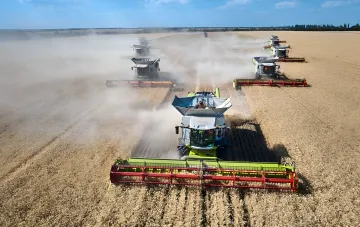
The sowing campaign in the current season costs Ukrainian farmers 15% more than in pre-war years, and prices for fuel and fertilizers have doubled. Vadaturskyi provides specific calculations: under an unfavorable price scenario, the economics of corn could turn negative by $500 per hectare, and wheat by $200 per hectare. On forecast sowing areas, this means a potential risk of losses exceeding $3 billion for just two main crops. According to the CEO of "Nibulon," these figures reflect not a hypothetical but a fully realistic scenario that is already taking shape in the market.
Chain reaction: from fields to banks
The shortage of working capital, Vadaturskyi forecasts, will push farmers to cut costs and reduce sowing areas. This, in turn, will lead to losses for exports, suppliers of agricultural machinery and fertilizers, local communities and, ultimately, the country's GDP. The danger is compounded by the fact that a significant part of the agricultural sector is financed through bank loans: mass farmer defaults could trigger a chain reaction and shift the crisis from the real sector into the banking one. For the state, Vadaturskyi emphasizes, it is far more advantageous to develop a support mechanism for viable enterprises now than to overcome the consequences of a systemic crisis later.
What business proposes: deferrals, restructuring and targeted loans
Vadaturskyi formulates a specific set of measures that, in his view, should be adopted jointly by the state, the National Bank of Ukraine and the banking sector. First and foremost — a mechanism for deferring the repayment of loan principal for enterprises affected by the war, and coordinated debt restructuring instead of chaotic collection. The second priority — providing targeted loans for the sowing campaign, resuming lending against grain, warehouse documents and export contracts. Implementing these measures requires state guarantees, the involvement of international financial institutions and mechanisms for covering war risks.
"The NBU cannot cancel losses with a regulator's decision"
Concluding his column, Vadaturskyi underscores a fundamental position: the regulator cannot, by a single decision, erase the economic losses inflicted by the war. They must be "honestly assessed and distributed" among the state, banks and international partners. In his words, it is precisely the joint distribution of war risks among the state, the NBU and business that can keep the agricultural sector from collapse and prevent an industry crisis from turning into a systemic financial one.