The Ministry of National Defense of South Korea announced on Thursday, August 24, 2026, that North Korea is continuing preparations to send a new contingent of troops to the Russian Federation. At the same time, the ministry emphasized that there are currently no signs of an immediate start to the deployment. The Defense Intelligence Agency (DODA) is monitoring logistical activity in North Korea's border regions, but no actual crossing of the border by the next echelon has yet been recorded. According to Kyiv's data, the total number of North Korean military personnel already on Russian territory has reached 8,500, including 400 unmanned systems operators.
New wave: drone operators in the spotlight
On August 21, just three days ago, it became known that another wave of North Korean military personnel had arrived in Russia. Unlike previous contingents, which were dominated by infantry units, this time a significant share of the arrivals are drone operators. Major General Vadym Skybietsky, Deputy Head of the Main Directorate of Intelligence of the Ministry of Defense of Ukraine, confirmed in a conversation with CNN that the total number of North Korean military personnel in the Russian Federation has reached 8,500, of whom 400 are drone control specialists. This indicates that Moscow is increasingly integrating the North Korean contingent into tasks related to the use of UAVs, which have become one of the key factors on the front.
More than 15 million shells: the scale of artillery aid
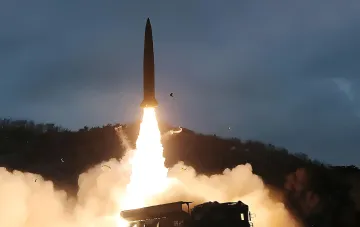
According to estimates by the South Korean defense ministry, North Korea has already supplied Russia with more than 15 million artillery shells equivalent to 152-millimeter caliber. For comparison: as late as July 2025, Seoul estimated this figure at 12 million shells. Thus, over the year the volume of deliveries has grown by at least 25%. In addition to artillery ammunition, Pyongyang continues to transfer to Moscow weapons systems, including short-range ballistic missiles. South Korean intelligence notes that the accuracy of these missiles in combat use has likely increased thanks to battlefield data, as well as technical advice and component supplies from Russian specialists.
Ballistic missiles and multiple launch rocket systems: development nearing completion
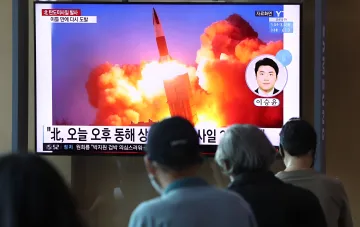
The Ministry of National Defense of South Korea also reported that the development of certain North Korean ballistic missiles and multiple launch rocket systems, which analysts believe are intended for a possible conflict with the Republic of Korea, is nearing completion. Particular attention should be paid to the medium-range ballistic missile "Hwasong-12," capable of reaching the US territory of Guam: according to Seoul, it is being prepared for operational deployment. North Korea's intercontinental missiles could theoretically reach the continental United States, however, key technologies — in particular, the re-entry of the warhead into the atmosphere — have not yet been tested under real conditions. All preliminary launches were conducted on a lofted trajectory, which does not allow confirming the system's operability in combat use along a standard ballistic trajectory.
Contradictory data
Open sources show discrepancies in assessing the pace and scale of the transfer. On the one hand, the headline of a number of Ukrainian media outlets (dialog.ua) frames the position as "the transfer of DPRK troops to Russia is not taking place," which reflects the South Korean intelligence conclusion that there are no signs of an immediate deployment. On the other hand, the same source and Ukrainian intelligence data confirm that preparations for a new dispatch are underway, and on August 21 another group of military personnel already arrived in the Russian Federation. Thus, the formulation "is not taking place" refers to the current moment (the absence of actual movement in the coming days), while strategic preparation and logistics continue. In addition, there is also a time gap in the question of the volume of shells delivered: RFI data from July 2025 indicates 12 million, while the current estimate by the South Korean Ministry of Defense is more than 15 million. The difference is explained by the dynamics of deliveries over the past 13 months, not by an error in the figures.
Context and prospects
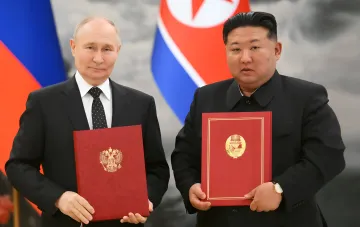
The situation with the North Korean contingent in Russia is evolving: from infantry units engaged in defensive operations, Moscow is moving to the involvement of UAV specialists and, presumably, to more complex tasks. The increase in the number of shells supplied by North Korea to 15 million indicates that Pyongyang remains one of the key suppliers of artillery ammunition for the Russian army. At the same time, North Korea is using cooperation with the Russian Federation to improve its own weapons: access to Russian components and combat experience allows it to accelerate the refinement of ballistic missiles and multiple launch rocket systems. For South Korea and its allies, this creates a dual challenge — both on the Ukrainian front and in the perspective of a potential conflict on the Korean Peninsula.