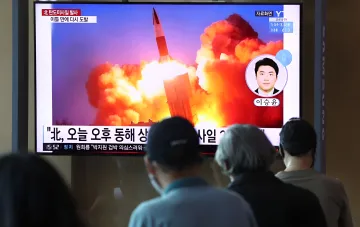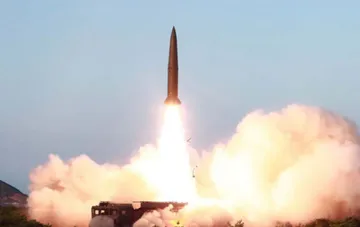
On Sunday, September 20, 2026, North Korea carried out a series of two missile launches from its eastern coast, separated by an interval of just three hours. According to the Republic of Korea's Joint Chiefs of Staff, the first projectile launched at approximately 15:00 local time from the Wonsan area and traveled roughly 450 kilometers over the East Sea. South Korean military officials classified it as a short-range ballistic missile (SRBM), while Japan's Ministry of Defense confirmed that the projectile was likely of a ballistic nature as well. Based on preliminary expert assessments, the missile may belong to the Hwasong-11 family — one of the most actively used types of tactical weaponry by Pyongyang.
Second Launch and Record Intensity
The second launch was recorded at approximately 17:50, i.e., about three hours after the first. According to South Korean data, the short-range missile covered a distance of more than 600 kilometers. If final identification confirms its ballistic character, this will set a precedent: North Korea will have conducted two consecutive ballistic missile tests in less than three hours. Japanese broadcaster NHK reported that the first missile landed outside Japan's exclusive economic zone, which rules out a direct threat to Japanese territory, but does not dispel questions about Pyongyang's intentions.
Reaction from Seoul, Tokyo, and Washington
In South Korea, the new launches were condemned at an emergency meeting of the National Security Council. Official Seoul called on Pyongyang to immediately cease its missile activities and stated that the ballistic missile tests violate existing UN Security Council resolutions. Japan also expressed its protest through diplomatic channels: the country's Defense Minister Shinjiro Koizumi stated that North Korea's actions pose a direct threat to Japan's security, the entire region, and the international community. According to Seoul, South Korean and American intelligence services had been tracking the situation since the first launch, and information about the incident was promptly relayed to Tokyo.
Contradictory Data
Fact-checking revealed significant discrepancies in the provided sources. First, the RFI material (source ID 3) describes the launch of an intercontinental ballistic missile (ICBM) into the Sea of Japan; however, based on the URL and publication date (December 2023), this event relates to a completely different episode and is unrelated to the current SRBM launches of September 20, 2026. Thus, this source neither confirms nor refutes the current news, but describes an incident from three years ago. Second, regarding the second projectile, the South Korean side initially used the phrasing "short-range missile" without specifying its ballistic character, whereas for the first launch the SRBM classification was given immediately. The final identification of the second object remained subject to clarification at the time of publication.
Escalation Context: Nuclear Program and Exercises near Guam
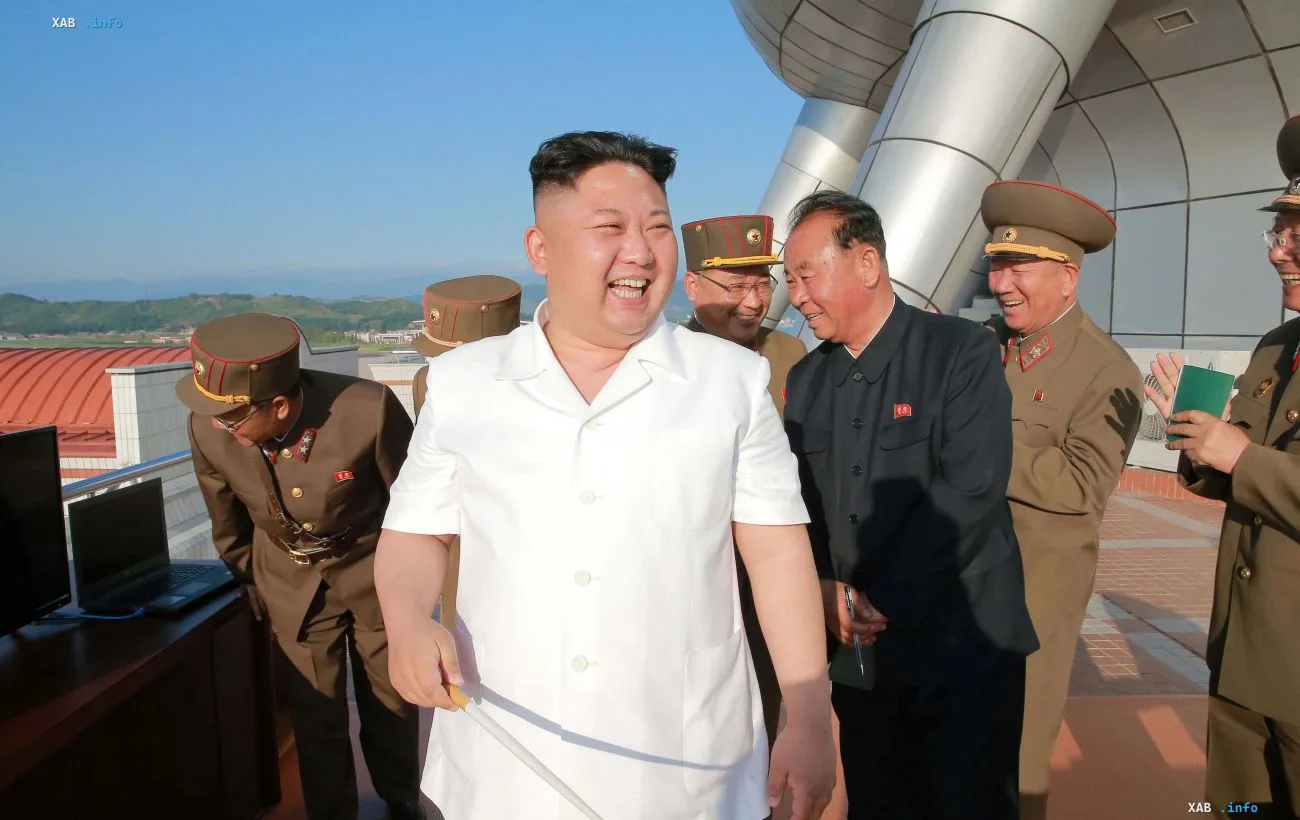
The new tests took place against the backdrop of sharply deteriorating relations between Pyongyang and regional countries. The day before, on September 19, North Korea rejected a resolution of the International Atomic Energy Agency (IAEA) concerning its nuclear program. In parallel, Pyongyang sharply criticized the U.S.-led naval exercises involving South Korea and Japan, which were held from August 29 to September 10 near Guam. Kim Yo-jong, sister of North Korean leader Kim Jong-un, publicly stated that such maneuvers "lead to further escalation of the situation on the Korean Peninsula," and confirmed that Pyongyang has no intention of changing its course toward strengthening its own nuclear arsenal. For North Korea, this is already the second series of missile tests in a week: on September 12, South Korean military also recorded launches of short-range ballistic missiles.
What This Means for Regional Security
The double launch within three hours demonstrates both Pyongyang's technical readiness for a series of launches and its political intent to exert maximum pressure on U.S. allies in the Asia-Pacific region. The combination of factors — the rejection of the IAEA resolution, criticism of the exercises near Guam, Kim Yo-jong's public statements, and the increasing frequency of launches — indicates that North Korea is using its missile program as a tool of diplomatic bargaining and a display of military power. For Japan and the Republic of Korea, the key question remains: will the next launches be accompanied by a change in trajectory toward the Japanese islands or South Korean territory, which would require the activation of missile defense systems.