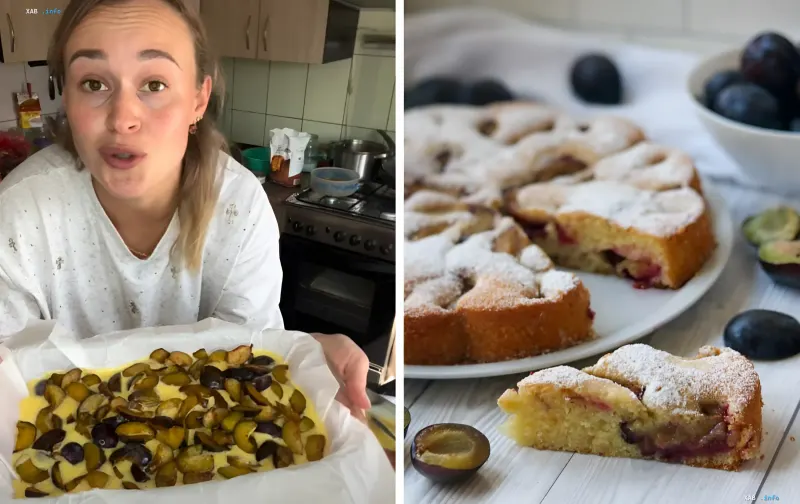
When you're craving something tasty to go with your tea but have neither the time nor the desire to weigh out ingredients on a kitchen scale, the so-called "one-cup" pie comes to the rescue. Its main appeal is its ultimate simplicity: the key dough ingredients are measured in equal amounts, using an ordinary cup as the guide. This is exactly what makes the recipe one of the most accessible for home baking, and the filling can be swapped out according to the season — berries, apples, pears, or, as in this case, plums. According to the publication Styler, an RBC-Ukraine project, the recipe is being popularized by blogger Alena Martyniuk.
The secret of the recipe lies in equal proportions
The foundation of the dough is built on four ingredients, each taken one cup at a time: flour, semolina, kefir, and sugar. To this "quartet" are added eggs, a little vegetable oil, baking soda, and the chosen filling. This set of ingredients requires no precise weighing, which lowers the barrier to entry for beginner bakers and minimizes the risk of error. All dough components are mixed in a bowl until smooth, after which the batter is poured into a baking pan.
Filling and baking process
Fruit or berries are laid on top of the dough — in the version being discussed, the author used plums, which give the baked good aroma and a light tang. The finished pie is baked at 180 degrees for about 40 minutes, though the Styler editorial team notes that the time may vary depending on the specific oven, so you should rely on your own appliance. After baking, the pie should be allowed to cool slightly before serving with tea.
Seasonal versatility
A separate advantage of the recipe is its flexibility. With plums, the pie turns out aromatic with a characteristic tang, whereas with other fruits or berries the flavor changes almost entirely. This allows you to use seasonal produce — fresh berries in summer, apples and pears in autumn, frozen stock in winter — without changing the basic technique. Thus, the same "cup-based" dough framework leaves room for experimentation, making the recipe convenient for regular use in a home kitchen.