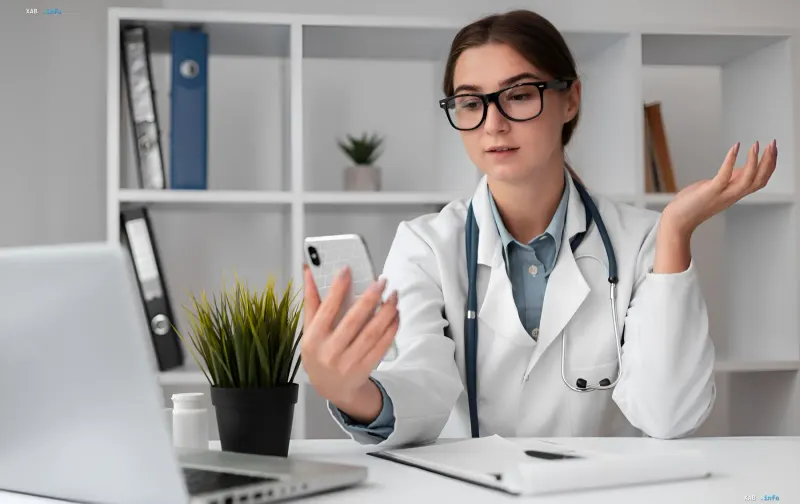
Online consultations in the beauty sector promise time savings and access to experts, but serious health risks often lurk behind this convenience. Cosmetologists and dermatologists warn: the remote format easily creates a false sense of a full consultation, while the doctor cannot see the actual condition of the skin and misses critically important details.
Exclusively for Wave RBC.UA, cosmetologist and dermatologist Daria Tishchenko revealed why selecting home care through a screen is not just a simplification, but a risk of serious error. In dermatology, a visual examination via camera is often insufficient. In the presence of rashes, dermatitis, pigmentation, or redness, the doctor needs to see the "bigger picture".
Blind Spots in Online Diagnostics
The problem lies not only in connection quality. In many cases, examining the face is not enough to make a diagnosis. The doctor must assess the condition of the neck, back, chest, scalp, and nails. A patient may not notice manifestations on the body or not understand their connection to the main complaint, but for a specialist, these are key markers.
Furthermore, technical factors distort reality. Poor lighting, the wrong angle, filter effects, image blurriness, or unstable connection change perception. It is difficult even to objectively assess the true skin color through a screen, making any conclusions risky.
The Myth of Simple Care Selection
Many patients mistakenly believe that sending a photo and describing symptoms is enough to receive a home care regimen. However, prescribing active ingredients requires a deep understanding of the skin barrier's condition. To safely prescribe acids, retinol, tretinoin, or professional protocols, the doctor must rule out irritation, dehydration, sensitivity, and active rashes.
People do not always know how to correctly describe their condition, and a photograph does not convey tactile sensations and nuances that a doctor sees during an in-person visit. An error in assessment can lead to the destruction of the skin's protective layer instead of healing.
The Danger of AI and Internet Advice
The situation is exacerbated by the trend of digitizing medicine. People are increasingly turning not to doctors, but to AI services and chatbots. According to Gallup, about 14 million adults in the US skipped a visit to a specialist after receiving a consultation from artificial intelligence. A KFF study predicts that by 2026, a third of American adults will turn to AI for health advice.
The problem is that neural network answers and advice from strangers on the internet often sound confident, logical, and structured. This creates an illusion of expertise, and the user perceives them as medical recommendations. In everyday matters, this may not be critical, but in cases of dermatitis or acne, the price of such an error is too high.
When Online Format Is Acceptable
Dermatologist Daria Tishchenko emphasizes: an online consultation can be useful, but only as an additional tool. It is justified if the doctor has already seen the patient in person, knows their history, prescribed a treatment plan, and is subsequently only clarifying dynamics or adjusting care. Using the remote format as the sole method of diagnosis is dangerous and ineffective.