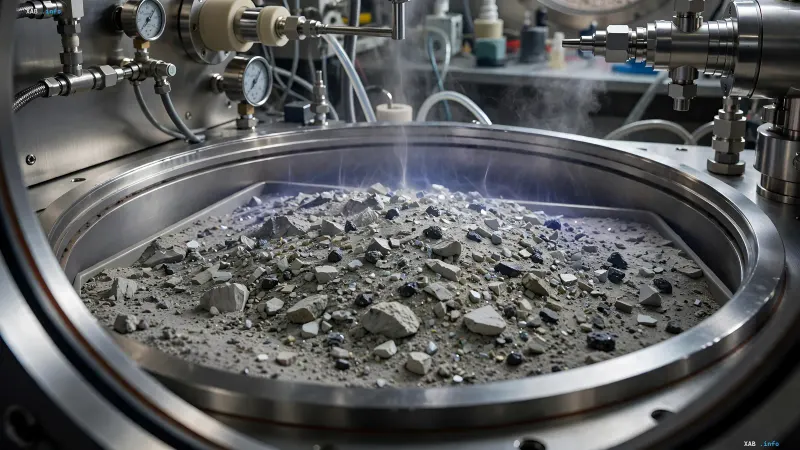
Researchers have demonstrated that oxygen can be extracted from lunar soil using a technology that the semiconductor industry has used for decades in microchip manufacturing. During the experiment, artificial lunar regolith was treated with fluorine-containing plasma, resulting in the release of oxygen, carbon dioxide, and carbon monoxide. The work shows that establishing life support systems and producing rocket fuel directly on Earth's satellite can rely on repurposing mature industrial methods rather than developing new ones from scratch.
Why Lunar Oxygen Is a Key Challenge for Satellite Exploration
Oxygen is present on the Moon in significant quantities, but not in a free state: it is chemically bound to the minerals that make up the surface layer, known as regolith. To obtain breathable gas or an oxidizer, strong chemical bonds must be broken. This makes in-situ oxygen extraction one of the main tasks for building lunar infrastructure: transporting large reserves of gas from Earth is extremely expensive, making local production critically important for the long-term presence of humans on the satellite.
A Plasma Approach Borrowed from Chipmaking
The study's authors tested an alternative approach — plasma treatment, which is used in the semiconductor industry to etch materials, particularly silicon dioxide (SiO₂), during the fabrication of electronic components. Plasma is an ionized gas containing charged particles and chemically active components capable of reacting with the treated material. In the experiment, two fluorine-containing compounds already used in semiconductor manufacturing processes were applied as plasma-forming gases: sulfur hexafluoride (SF₆) and octafluorocyclobutane (C₄F₈).
What the Experiment Showed
Samples of lunar regolith simulant — a mineral mixture replicating the composition of lunar soil — were exposed to plasma without liquid chemical reagents and at temperatures below 400 °C. The released substances and mineral changes were studied using X-ray spectroscopy, X-ray diffraction, and photoelectron spectroscopy. The analysis showed that different plasma compositions affect minerals differently: SF₆ plasma primarily reacted with anorthosite, a rock rich in feldspars, whereas C₄F₈ treatment affected other components of the simulated regolith as well. Meanwhile, the chemical mechanisms of oxygen release in both cases align with the mechanisms of silicon dioxide plasma etching known in microchip manufacturing, allowing researchers to build upon the semiconductor industry's accumulated knowledge of how fluorine-containing plasma interacts with oxygen-containing materials.
How Far We Are from a Real Lunar Plant
Despite the method's fundamental viability, practical oxygen extraction on the Moon is still a long way off. Experiments were conducted only with artificial soil rather than samples brought back from the satellite's surface, so transferring the results to actual regolith requires additional verification. Furthermore, the amount of oxygen produced must be significantly scaled up before the technology can be used in an actual lunar facility. Scientists still need to thoroughly understand the reaction mechanisms, increase product yield, and assess the economic feasibility of scaling the process to an industrial level.