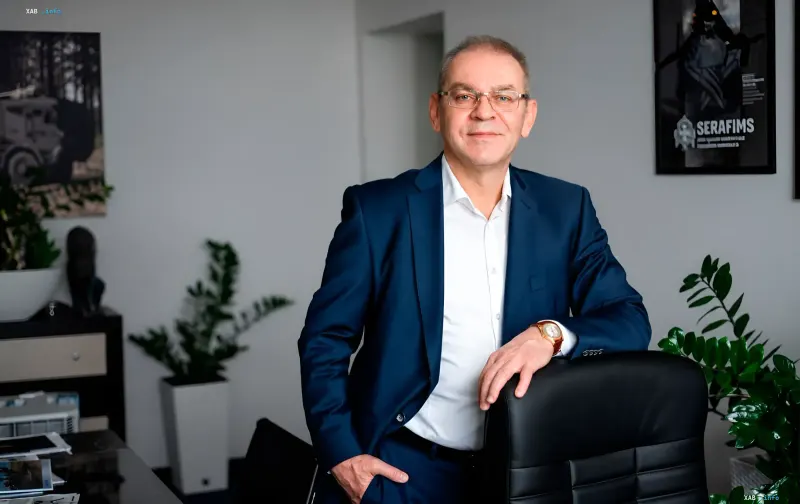
Former Head of the Presidential Administration of Ukraine Serhiy Pashynskyi, in an interview with the German newspaper Berliner Zeitung published in a translation by RBC-Ukraine, summarized 35 years of the country's independence and assessed the course of the war with Russia. According to him, Moscow has not abandoned its imperial ambitions, and peace with it is impossible without Russia acknowledging responsibility for the aggression. Pashynskyi also emphasized that Ukraine must be prepared for new threats — with a strong army and a powerful domestic defense industry. The conversation took place against the backdrop of the 35th anniversary of independence and the fifth year of full-scale war.
Historical Roots of the Conflict
Pashynskyi insists that the roots of the current war extend far beyond February 24, 2022: he traces them back to the annexation of Crimea in 2014, the Orange Revolution of 2004, the independence referendum of 1991, and all the way to the Ukrainian People's Republic, proclaimed in 1917 and crushed by the Red Army four years later. In his assessment, Moscow justifies its claims with history — from Kievan Rus to the thesis of the unity of Russians and Ukrainians — while Kyiv contrasts this with the Holodomor, the annihilated generation of poets of the 1930s, and its own European history. "The war for territories was preceded by a struggle for memory and identity," summarizes the former Head of the Presidential Administration.
Three Decades of Unjustified Security Assurances
Between these events, according to Pashynskyi, lie three decades of unjustified security assurances. In 1991, Ukraine inherited the world's third-largest nuclear arsenal, which it transferred to Russia by 1996; in response, Russia, the US, and the UK committed in the Budapest Memorandum to respect its borders — but without obligations for military assistance. In 2008, NATO declared the prospect of membership but offered no concrete path toward it, and the Minsk agreements of 2014 and 2015 failed to ensure a lasting ceasefire. When Russia launched a full-scale invasion in 2022, Ukraine, in Pashynskyi's assessment, was left without binding guarantees of military protection.
Personal Role in Decisive Moments
Pashynskyi exerted direct influence on the course of this history at key moments: he was at the Maidan from day one, and in 2014, during the annexation of Crimea, he headed the Presidential Administration — during those weeks when, according to him, there were not even enough vehicles to redeploy a brigade. He recalls how the head of the State Guard Administration urgently demanded portable anti-aircraft missiles from him: a Russian airborne assault from helicopters was, according to that intelligence, supposed to land on the roof of the Cabinet of Ministers building. In November 2021, Pashynskyi publicly predicted a large-scale invasion, although, by his own admission, close people thought he was crazy.
Strategic Mistakes of 1991
Answering a question about strategic mistakes that cannot be explained by the actions of Russia or the West, Pashynskyi points out: formally, Ukraine had the status of a separate republic since 1919, but de facto it was a colony of the Russian Empire, which transformed into the Soviet Union. The national elite was destroyed, management personnel loyal to Moscow moved to the center, and ideologically, politically, and organizationally the country was not ready for state-building. He refers to George H.W. Bush's speech in the Ukrainian parliament — the so-called "Chicken Kyiv speech" — and notes that, judging by advisors' memoirs, Bush feared not so much Ukraine's independence as the Yugoslav scenario of wars through which the imperial center tried to hold onto the republics. According to him, the war did not start earlier only because of the weakness of post-Soviet Russia and Ukraine's close ties with the former center; when the gradual absorption strategy failed, Moscow resorted to military means.
Failure of Elites and Lessons for the Future
Pashynskyi admits that the political and administrative elites failed to cope with the task of defending the country: society did not yet understand what the formation of a nation meant, and only a small part of the elite retained a clear vision of Ukraine as a national state. In the 1990s, he says, Soviet institutions were liquidated without a thought given to creating national ones, and the country lost almost all of its inherited economic potential. Only after 2000 did progress begin: hyperinflation was stopped, Western-type enterprises appeared, democracy began to take shape, and society began to strive for Western forms of organization and freedom. It is against this backdrop, Pashynskyi is convinced, that Ukraine must build a strong army and its own defense industry to be ready for new threats and not depend on someone else's security guarantees.