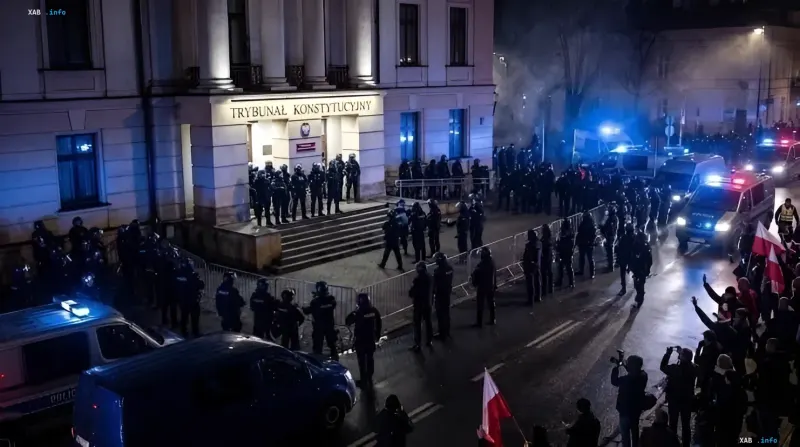
On Saturday, October 31, 2026, Polish President Karol Nawrocki convened emergency talks with parliamentary party representatives, stating that the country's constitutional order had been violated following a nighttime clash near the Constitutional Tribunal building in Warsaw. 'This night, an act violating the constitutional order of the Republic of Poland and unlawfully seizing a constitutional state institution was committed,' the head of state declared. According to him, the meeting was called 'with the aim of stabilizing the political situation and restoring constitutional order' amid threats to internal security.
Nighttime Confrontation at the Tribunal Building
The president interrupted his official visit to Senegal and returned to Warsaw on Friday evening, and at around 1:00 AM, he stated he arrived at the Constitutional Tribunal building 'despite obstacles'. Inside, he met with Anna Korwin-Piotrowska, who, citing her status as the judge with the most seniority, issued an order suspending the powers of acting Tribunal President Bogdan Święczkowski and Deputy President Bartłomiej Sochański, declaring herself acting president. At the request of Korwin-Piotrowska and the Prosecutor General, the building was surrounded by special police units. Nawrocki stated he remained inside the building until nearly 5:00 AM, after which he ordered the police to withdraw from the court grounds. During the night, clashes also occurred between demonstrators and law enforcement near the building, and additional forces were brought in to secure the area.
Roots of the Crisis: The Struggle for Court Leadership
Instability surrounding the Constitutional Tribunal has persisted since Prime Minister Donald Tusk's coalition came to power in 2023, when plans to change the Tribunal's leadership were put forward. Following Nawrocki's election as president in 2025, these plans were blocked, according to him: he refused to swear in new judges appointed by the parliament, where the governing coalition dominates. The opposition Law and Justice (PiS) party supports this stance. Amid the dispute over the court's leadership, Prime Minister Tusk appointed former government member Maciej Berek as a tribunal judge, after which protests began to take place outside the courthouse.
Positions of the Parties and International Commentary
The parties offer mutually exclusive assessments of the events. The opposition rejected Korwin-Piotrowska's statement, accusing her and Prime Minister Tusk's administration of an 'illegal seizure of power' and a 'coup d'état'; the Tribunal itself reportedly also spoke of a 'coup d'état' amid the standoff. Nawrocki, in turn, after leaving the court, announced its 'forcible seizure' and stated he had consulted with Supreme Court First President Zbigniew Kapiński, who, according to him, 'also does not recognize as lawful the actions undertaken by the usurpers of power'. Prosecutor General Waldemar Żurek, conversely, criticized the president's actions and announced an investigation into 'people from the presidential chancellery' and Nawrocki himself, calling their actions 'scandalous and unacceptable'. Polish media characterize the situation as a deep political crisis dividing the country into two opposing camps, with street protests breaking out. Abroad, the events were also commented on: reports indicate Russian leader Dmitry Medvedev called what is happening in Poland a coup.
What's Next
The urgent meeting with parliamentary forces convened by Nawrocki is intended, according to the president, to stabilize the situation and restore constitutional order. However, until the parties reach an agreement on the legality of each other's actions and the status of the Tribunal's leadership, political confrontation in Poland is likely to persist, and the question of whose interpretation of events aligns with the constitution remains open.