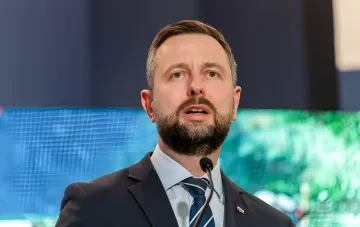
Poland's Ministry of National Defense has publicly stated its position on one of the most sensitive issues in European security: Warsaw has no intention of hosting US nuclear warheads on its territory. This was declared by Deputy Minister of National Defense Paweł Zalewski during a visit to NATO headquarters in Brussels. At the same time, as Zalewski himself emphasized, Poland is simultaneously conducting active negotiations with Washington on strengthening the permanent military presence of US forces on its soil — meaning that strengthening the conventional component and renouncing nuclear weapons in Warsaw are viewed as two compatible, rather than contradictory, directions.
"Very Clearly and Openly": Warsaw's Position
In response to journalists' questions, Zalewski stressed the unambiguous nature of the wording. "I would like to say this very clearly and openly. Poland does not want to have nuclear warheads on its territory," the deputy minister stated. According to him, even in a scenario where the US military presence in Poland is expanded, the deployment of nuclear weapons is not part of that logic. Thus, Warsaw has separated the issue of conventional support from nuclear deterrence and publicly closed off the option of hosting foreign nuclear warheads.
NATO Concept 3.0 and Europe's Responsibility
During the meeting between Zalewski and US Deputy Secretary of Defense Elbridge Colby, the sides discussed, among other things, the implementation of so-called NATO Concept 3.0. This refers to an approach in which European countries take on greater responsibility for the security of their own continent. Poland, according to Zalewski, supports this direction and wants to actively participate in developing a stronger Alliance. "Poland is a supporter of this mindset," the deputy minister emphasized, linking the rejection of nuclear warheads to a broader strategy of strengthening Europe's conventional capabilities.
Negotiations on Permanent US Bases
Warsaw and Washington continue to discuss the permanent military presence of US troops in Poland. According to Zalewski, the negotiations cover several potential locations where US military bases could be established, and a representative of the US administration is expected to visit Poland in the near future to review Poland's proposals. "In fact, it is about several bases, several locations where American soldiers will be permanently stationed in Poland," he said, adding that the US has such important interests in Poland that it is interested in a permanent presence of its military.
The European "Nuclear Umbrella": Context
Poland's statement came against the backdrop of shifting moods in US international politics, which have led an increasing number of European countries to consider so-called "nuclear umbrellas." Berlin, for example, is considering financing the nuclear capabilities of France and the United Kingdom, while not seeking to acquire its own nuclear weapons. Poland and France, in turn, have begun concrete negotiations on a "nuclear umbrella" and held the first meeting of a special coordination group. The President of Lithuania announced the repeal of the constitutional ban on nuclear weapons, and it is expected that the country's legislature will begin introducing the corresponding amendments. Against this backdrop, Poland's rejection of hosting US warheads appears as a deliberate choice: to strengthen conventional defense and seek European deterrence options without becoming a platform for foreign nuclear weapons.