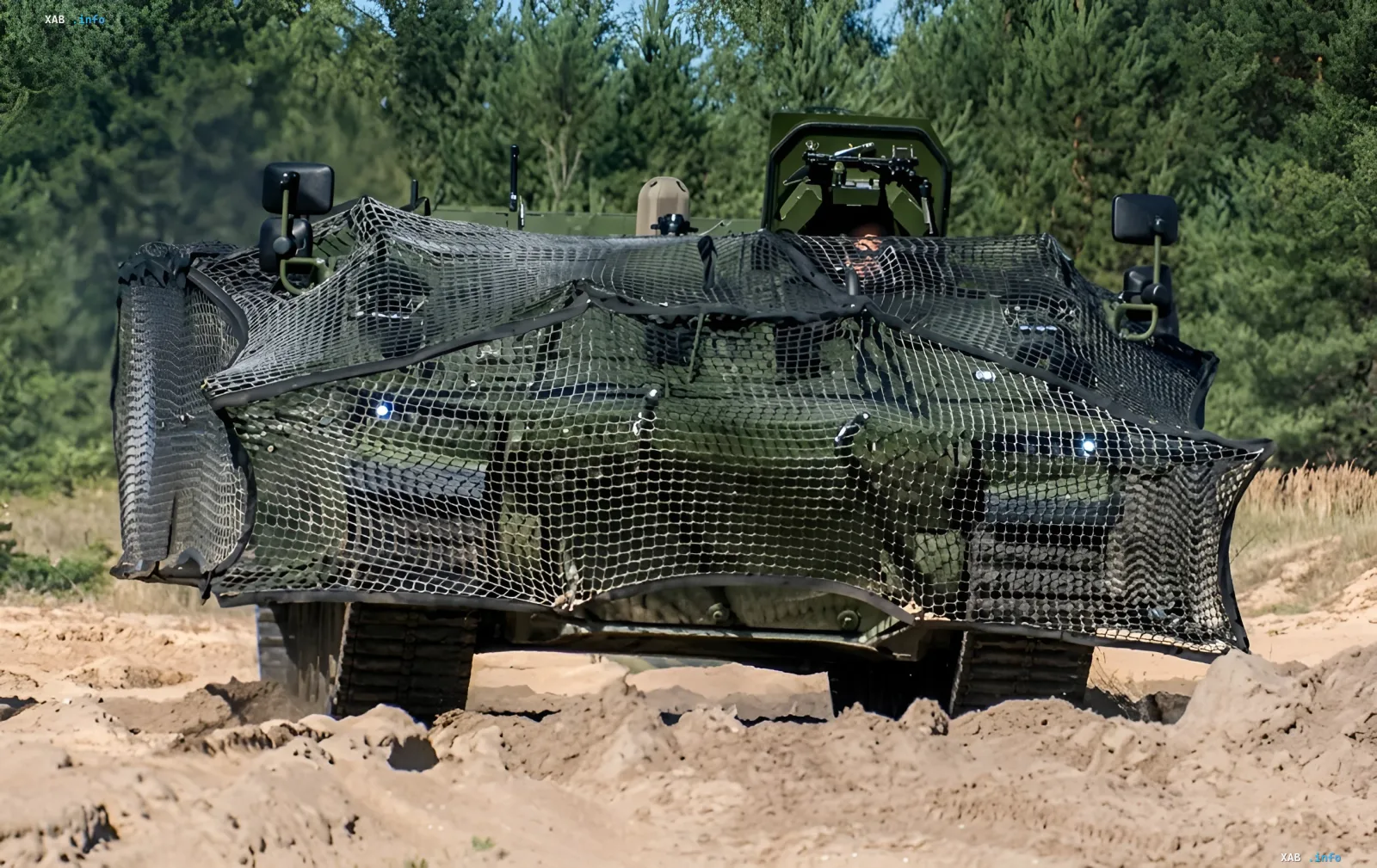
The Latvian Ministry of Defence held a demonstration of anti-drone systems mounted on the new Hunter infantry fighting vehicle at the Adazi military base. This is reported by RBC-Ukraine, citing the Latvian public broadcaster LSM. The showcase was, in effect, Riga's last chance to settle on a set of air-defence measures before the vehicles officially enter service, rather than having to add them later, after the fact.
What Was Shown at Adazi Base
The Hunter IFV, known in Latvian as the “Mednieks,” was fitted with equipment from the Spanish company GDELS-Santa Bárbara Sistemas — the same manufacturer supplying Latvia with the vehicle itself. As the report notes, the demonstration took place on Thursday and was timed to the final stage of preparing the vehicles for handover: the first vehicles are due to reach the National Armed Forces in October, which is precisely why Riga could lock in the anti-drone protection configuration now without having to rework already serial-produced models.
Active and Passive Systems: How the Protection Works
During the trials, two classes of equipment were tested. Active systems are capable of independently engaging approaching drones, while passive ones merely detect the threat and warn the crew. In parallel, the vehicle's interaction with Latvia's ground drones was tested — drones that do not operate against the Hunter but alongside it, detecting enemy drones and jamming their signal. According to the outlet, this approach mirrors the logic of trials previously conducted by the U.S. Army on its own vehicles: fitting armoured vehicles with equipment able to shoot down or jam a small drone before it drops a grenade or dives onto the armour from above.
The ASCOD Platform and the Vehicle's Path to the Troops
The Hunter is built on the ASCOD platform, used by several NATO countries and localised to suit Latvia's needs. The vehicle was modernised for contemporary mechanised infantry operations, with an emphasis on firepower, modular armour, and interoperability with allied equipment. The name for the IFV was chosen by the soldiers of the Mechanised Infantry Brigade, who will subsequently command it. Latvia signed its first contract for 42 Hunter vehicles with GDELS-Santa Bárbara Sistemas in January 2025, and by June of the same year had doubled the order to 84 units.
Contradictory Data
There is a discrepancy here that warrants separate mention. On the one hand, the Latvian Prime Minister previously acknowledged that the country had purchased specialised anti-drone systems to counter Russian attacks but had not secured the ammunition for them. On the other hand, at Adazi base they are demonstrating active systems mounted on the IFV itself, which by definition require their own means of engagement. The outlet does not clarify whether the systems shown on the vehicle fall into the same category the Prime Minister referred to, or whether this is a separate, later stage of equipping. Thus, two versions are publicly on the table: either the ammunition shortage concerns national stationary/portable systems, while the vehicle receives its own autonomous protection, or the demonstration itself is the answer to the previously acknowledged gap. No official clarification is provided in the available materials.
Regional Context: Why This Matters Now
The looming threat is well understood in the region: Russia's war against Ukraine has shown how cheap FPV drones can disable armoured vehicles worth millions of dollars, and Latvia borders NATO's eastern frontier with Russia directly. The issue of air threats for the country sharpened even before this month, when NATO fighter jets shot down a drone that strayed into Latvian airspace in the area of several municipalities on the border with Belarus and Russia. Against this backdrop, the demonstration at Adazi looks less like a training episode and more like practical preparation to ensure that every new unit of armoured vehicle enters service already equipped with a ready answer to the region's main air threat.