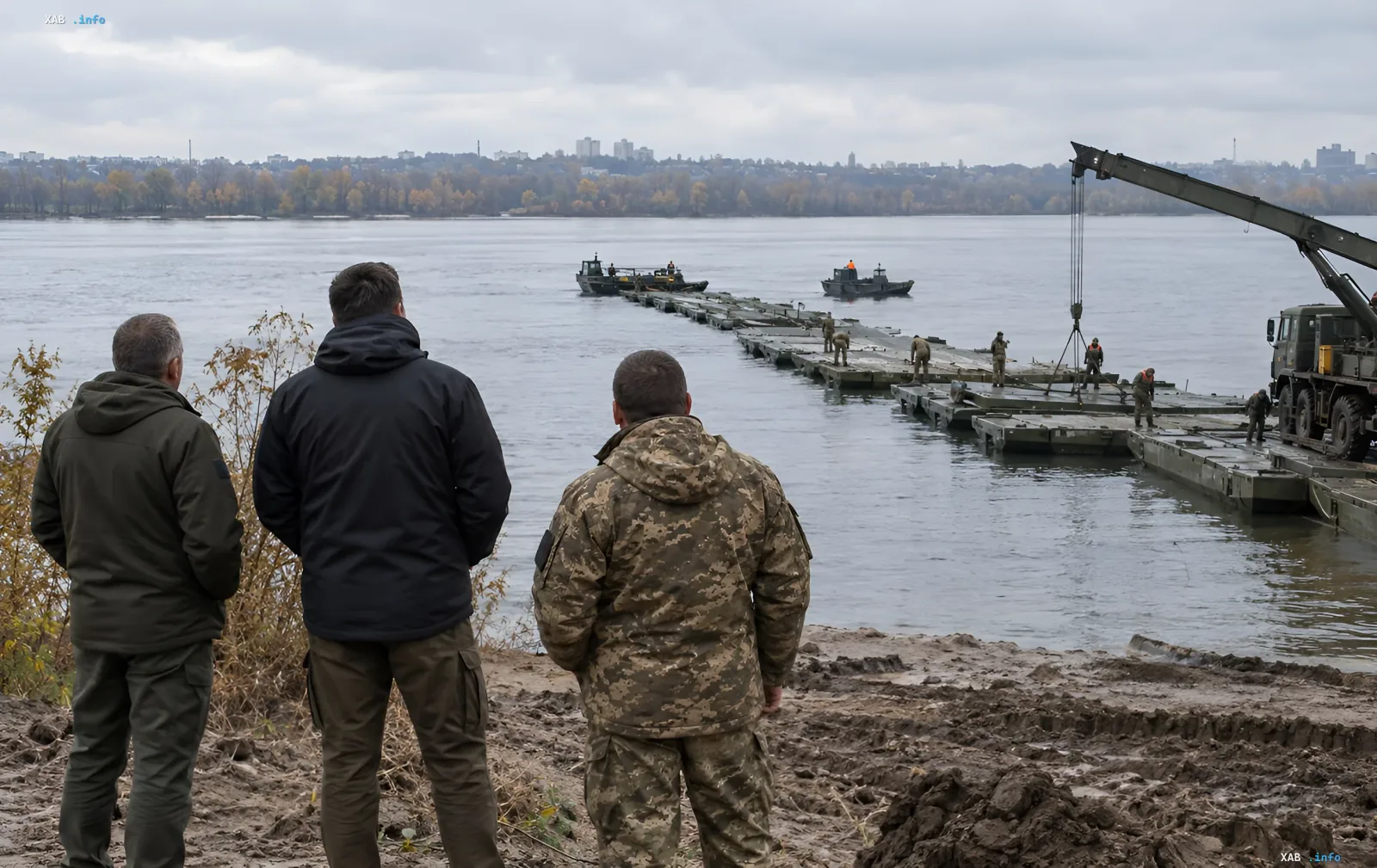
Amid regular enemy attacks that have begun to damage the capital's bridges, Kyiv is considering the installation of pontoon crossings to maintain logistics. However, experts note that implementing this idea involves colossal technical, temporal, and financial difficulties, meaning pontoons will not be able to fully replace permanent structures.
Technical Realities and the Time Factor
Transport planning expert Dmytro Bespalov noted in a blitz interview that technically installing pontoons in Kyiv is feasible, as the military built similar crossings back in the 1940s. The pontoons themselves deploy quickly since they were created as army assets for the rapid transfer of equipment. Nevertheless, in addition to the structures themselves, moorings will need to be equipped and access roads laid, which could take months.
Throughput Capacity and the Purpose of PMP
Pontoon-bridge parks (PMP) are primarily intended for military purposes—operational evacuation or logistical support—rather than for daily commutes of citizens from left-bank residential areas to right-bank offices. Although pontoons can pass passenger cars and public transport, they are not designed for the intensive flow that Kyiv's bridges provide daily. The Minister of Reconstruction announced plans to provide half of the bridges' throughput capacity with alternative crossings, but this would require 15 to 20 sets.
Financial Aspect and Hidden Threats
Following a closed meeting of the Kyiv City Council, information leaked to the media that creating a system of pontoon crossings across the Dnieper is estimated at around 8 billion hryvnias. Although experts struggle to name an exact budget due to a lack of data on the availability of sets, it is obvious that we are talking about tens of millions of dollars and colossal costs for regular maintenance.
Contradictory Data
While officials announce large-scale plans to build backup dams and pontoon crossings to cover half of the bridges' throughput capacity, transport experts call such initiatives extremely unrealistic. Discrepancies concern both the deployment timelines of the structures and their actual cost: official estimates reach 8 billion hryvnias, while independent specialists point to a shortage of PMP sets on the market and the need to source them abroad.
Conclusions and Survival Mode
The operation of pontoon crossings is complicated by seasonal factors, such as spring floods or river freezing, requiring constant monitoring. In addition, PMPs are much more vulnerable to drone strikes than reinforced concrete bridges and require enhanced protection. According to analysts, the massive deployment of pontoons will be a troubling sign of the capital entering an extreme survival mode.