
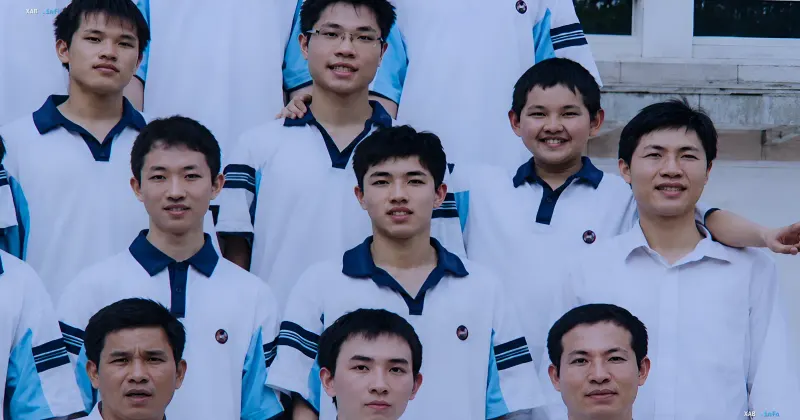
Kung Ming is a name that has become synonymous with phenomenal success in China. Today, at 29, he is a mathematics professor and holds three academic degrees from one of the country's leading universities — the University of Science and Technology of China. His story seems like a classic fairy tale of how talent can change destiny. However, in a recent interview, Kung Ming himself offered a different, much more sober assessment of his path.
The "Wonderkid" Movement and a Grandfather's Dream
The story begins in the late 1990s. At that time, a movement glorifying child prodigies was gaining momentum in China. The initiator and driving force in Kung Ming's life was his maternal grandfather. Unable to realize his own dreams of education, the grandfather dedicated his life to studying models for educating gifted children and pinned all his hopes on his grandson.
The results exceeded expectations. Kung Ming completed elementary school on his own at age 5, middle school at 6, high school at 9, and by 12, he was already a university student. But behind these figures lay a complex reality. To find a school willing to accept such a young student, the grandfather took the boy all over the country: from Shanxi and Jiangsu to Guangzhou, Foshan, and Hefei. Schools refused him due to his minority status, lack of documents, and concerns about the child's psyche in an environment of peers who were almost ten years older.
Loneliness in a Classroom of Adults
Looking back on that time, Kung Ming admits that he felt not so much suffering as a deep sense of being lost. At 6 years old, he didn't understand why he had to leave his family and live in rented houses in unfamiliar cities. While his peers played and made friends, he could only silently observe their lives through the window.
"Instead of formal addresses, students often affectionately called me 'Professor Kung'," he recalls regarding the present day. "I was present in their chats, they shared their daily lives with me." For a person who grew up without friends and always felt like an outsider, such acceptance became a reward.
The Price of Accelerated Learning
Many believe that the earlier you start, the higher your chances of success. Kung Ming asserts that reality is more complex. The letter of admission to the program for gifted children did not make his path easier. On the contrary, as he delved deeper into science, gaps in his knowledge became obvious.
"I do not believe that skipping grades provides any special advantages," he stated. Due to an insufficient knowledge base, he had to spend a lot of time filling in gaps when moving on to his doctoral dissertation. In the first years of his work, his scientific achievements were significantly lower than those of colleagues who studied under the standard program.
Kung Ming warns: accelerated learning can help achieve high results in the short term, but it easily leads to a child missing important stages in the formation of a comprehensive knowledge base and the development of social skills.
Ordinary Life — The Best Reward
Today, Kung Ming teaches at a university. His academic reputation is impeccable, but compared to the expectations once placed on him as a "wonderkid," his life seems quite ordinary to many. He himself does not think so. What pleases him most is that the age difference between him and his students is small. He no longer feels like an outsider. And perhaps it is precisely in this — in the ability to be simply a person among people — that true success lies.