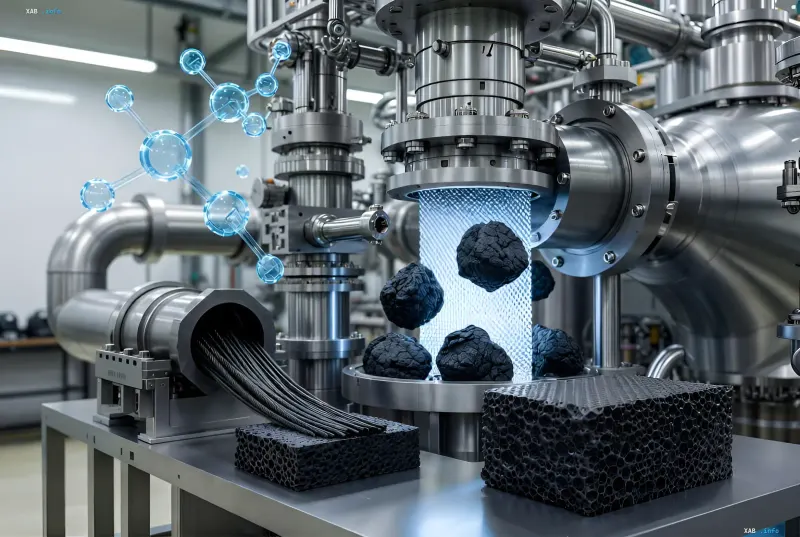
An industry conference held in China's Shanxi province showcased an innovative technology capable of radically changing the perception of coal usage. Developers demonstrated a method to transform ordinary fossil fuel into high-tech carbon materials, including graphene, carbon fiber, and components for supercapacitors.
Joint Project and Expert Evaluation
The technology is the result of a collaboration between Zhaoqing Shunxin Coal Chemical Industry Technology and the Guangdong Coal-based Carbon Materials Research Center. In 2025, the project successfully passed an expert evaluation by the China International Association for the Promotion of Science and Technology. Experts highly rated the potential of the development and recommended accelerating its market launch.
Working Principle: Quantum Chemistry Instead of Combustion
Unlike traditional methods where coal is used exclusively for electricity or heat generation, the new process focuses on extracting valuable carbon compounds. The project authors claim that the technology is based on the principles of quantum chemistry.
The essence of the process lies in separating coal molecules based on the strength of chemical bonds:
- Less stable bonds are broken down, turning into liquid and gaseous products.
- The most stable aromatic structures are preserved and used to produce condensed pitch.
It is this pitch that becomes the key raw material for producing modern materials with unique properties.
Wide Range of Applications
Based on the obtained raw materials, the technology allows for the production of a wide range of products:
- Carbon fiber and carbon foam.
- Three-dimensional graphene.
- High-purity activated carbon.
- Materials for supercapacitors.
Such products are in high demand in the aerospace industry, electronics, energy storage systems, and other high-tech economic sectors.
Environmental Impact and Economic Efficiency
One of the main advantages of the method is its environmental friendliness. The technology allows for the conversion of about 60% of the carbon contained in coal into finished products, rather than releasing it into the atmosphere during combustion. According to scientists' estimates, processing one ton of coal in this way can reduce carbon dioxide emissions by approximately two tons compared to traditional methods.
Transition to Industrial Production
To commercially implement the technology, the first step has already been taken: an agreement has been signed with the state-owned company China Pingmei Shenma Group. A facility is planned to be built in Henan province, capable of producing up to 6,000 tons of carbon materials per year.
Developers also report that some products have already undergone testing with potential customers and are preparing for serial production. However, despite the loud claims, the technology is still at the stage of transitioning from laboratory and pilot projects to full-scale industrial production. Its economic efficiency and compliance with stated characteristics still need to be finally confirmed under mass production conditions.