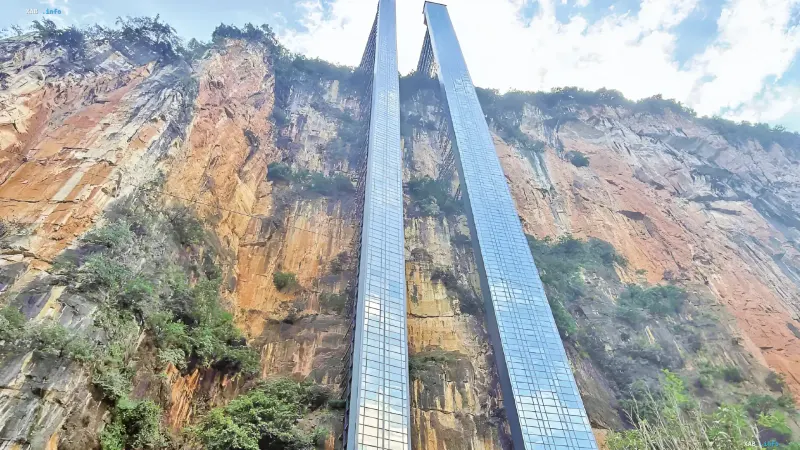
On August 17, 2026, news emerged of the completion of a major infrastructure project in a remote corner of China. In the village of Nizhuhe, located in Yunnan province, a giant vertical elevator 288 meters high has officially been put into operation. This engineering structure, named the "Fuyao Ladder," aims to solve one of the region's most pressing social problems — ensuring safe access to education for children living in inaccessible mountain gorges.
Technological breakthrough in the mountains of Yunnan
The new elevator represents a modern engineering solution made of transparent glass, providing a 360-degree panoramic view during the ascent. The structure allows passengers to enjoy views of the sheer cliffs and gorges while overcoming a height of 288 meters at a speed of 5 meters per second. The "Fuyao Ladder" has become the second such facility in the area, complementing the existing 268-meter "Kingyun Ladder" elevator, which was put into operation in 2022. The combined capacity of both elevators is an impressive 1,200 people per hour, allowing for the efficient service of both local residents and tourists.
Revolution in school transport: from three hours to five minutes
The main goal of the elevator construction is humanitarian. Before the facility was put into operation, children from the village of Nizhuhe had to overcome an exhausting journey to school, located on the summit of Mount Guangzhai (height about 1,650 meters). Students aged 6 to 15 were forced to climb steep and dangerous mountain trails, which took up to three hours one way. Now the route has changed radically: children get to the foot of the elevator by bus, then rise to the platform in a matter of minutes and complete the journey by aerial cableway. The total travel time has been reduced to a few minutes, making daily trips to school safe and comfortable.
Economic impact and tourism potential
In addition to its social significance, the "Fuyao Ladder" project has become a powerful driver of local tourism development. Infrastructure, previously focused mainly on the needs of residents, now attracts travelers from all over the world. Thanks to the introduction of the new elevator, the daily capacity of the area has increased from 4,000 to 15,000 visitors. This indicates that engineering solutions in remote regions can become a catalyst for economic growth, turning logistical problems into tourist attractions.
Context of world records
China continues to hold the leadership in the construction of high-altitude open-air elevators. For comparison, the Bailong Elevator remains the highest open-air elevator in the world, rising along a sheer cliff to a height of 326 meters. However, as experts note, the main significance of the structure in Nizhuhe lies not in the pursuit of height records, but in its practical utility. This is an example of how modern engineering serves the interests of education and citizen safety, eliminating geographical barriers.