The first autumn frosts do not mean that all young trees and shrubs need to be covered immediately. As experts at Iowa State University explain, hardy plants usually tolerate brief cold snaps without canopy protection, and a gradual temperature drop helps them enter dormancy. However, heat-loving crops and potted saplings may require additional protection. Before taking action, it is important to check the cold hardiness of the specific species and variety, assess the plant's condition, and review the overnight weather forecast.
Mulching and Watering: The Foundation of Root System Preparation
Specialists from the State Consumer Protection Service in Ternopil region recommend paying attention to autumn watering and garden mulching: these measures help prepare the root system for winter conditions. According to University of Minnesota recommendations, organic mulch about 7–8 cm thick—such as wood chips—should be laid around newly planted trees and shrubs. Before a cold snap, it is necessary to check soil moisture: if it has dried out and is not yet frozen, the root zone should be watered. At the same time, it is important to prevent water stagnation, especially in areas with poor drainage.
How to Properly Use Covering Material
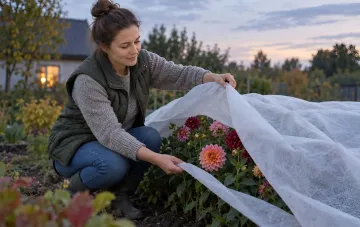
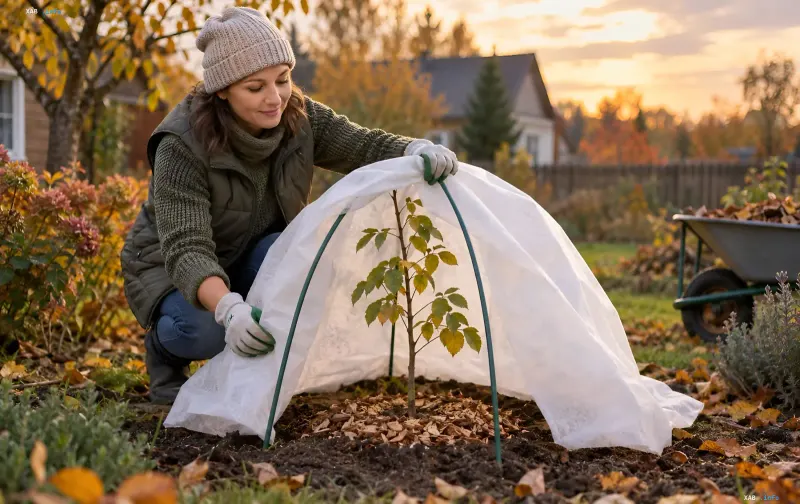
For plants sensitive to brief cold snaps, white covering agrotextile, specifically spunbond, is suitable. It allows air and water to pass through, eliminating the greenhouse effect. The Royal Horticultural Society in Great Britain notes that thicker fabric provides better protection from the cold than thin material: a 35 g/m² material protects better than 17 g/m². If necessary, the agrotextile can be applied in two layers. Specialists at the Louisiana State University Agricultural Center advise extending the covering material all the way to the ground—this helps retain heat radiated by the soil. It is strictly not recommended to wrap the canopy with airtight polyethylene film: in sunny weather, excessive heat and moisture accumulate under it, which can destroy the plant.
Container Plants Require a Special Approach
Roots in containers are more vulnerable to cold than those in open ground, so canopy protection alone may not be enough. If brief frosts are expected, pots with hardy plants can be moved to a wind-protected spot, and the containers wrapped in burlap or another suitable material for extra insulation. Heat-loving saplings that cannot withstand the predicted cold are best moved indoors to a suitable temperature beforehand. If the plants remain in containers until spring, wintering conditions must be selected individually: according to the Ukrainian garden center WestGard, deciduous plants in a dormant state can be stored in a cool basement, while conifers require a bright room. Throughout the winter, substrate moisture should be checked and watered as needed, avoiding both complete drying and waterlogging.
What Not to Do
Covering does not guarantee protection for heat-loving plants during severe or prolonged frosts—they may require different storage conditions. In addition, the SES reminds people of the ban on burning dry grass and plant residues: attempting to create a "smoke screen" to protect saplings from the cold is not only ineffective but also creates fire risks and harms the environment and human health. Covering material is a reliable tool, but it only works within reasonable temperature limits and with proper application.