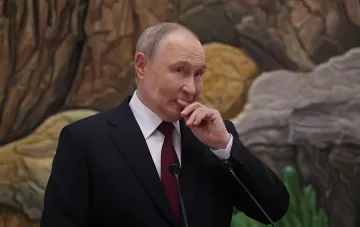
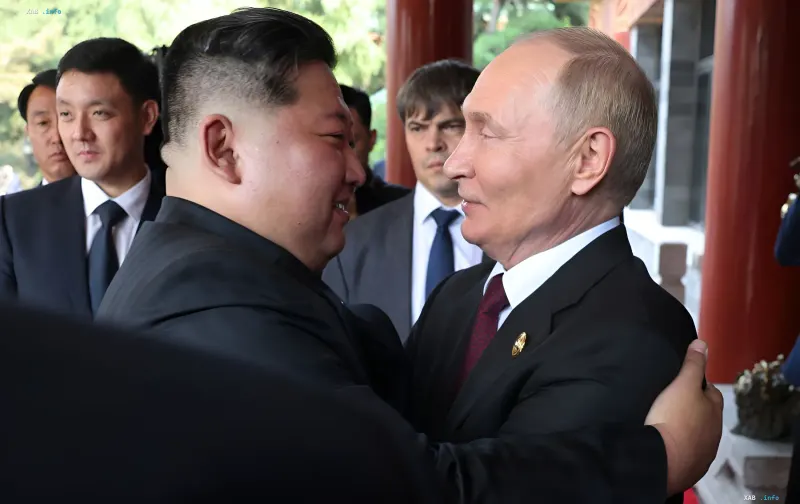
On August 14, 2026, marking the anniversary of Korea's liberation from Japanese colonial rule, relations between Moscow and Pyongyang reached a new point of tension and strategic closeness. Russian leader Vladimir Putin, in his message to North Korean leader Kim Jong Un, declared total coordination of efforts for regional security. On the same day, Kim Jong Un personally visited the Tower of Reunification in Pyongyang, laying a wreath at the monument to Soviet soldiers with the inscription: 'We do not forget the feat of Soviet soldier-martyrs.' According to the North Korean leader, the legacy of 'blood ties' and 'military friendship' has become the foundation for deepening partnership in current geopolitical realities.
Rhetoric Escalation: 'Threshold of Nuclear War'
The backdrop for the diplomatic statements of the leaders of the two countries is extremely alarming. On August 14, Pyongyang officially warned that the world is on the 'threshold of nuclear war.' The reason for such harsh rhetoric was the planned joint military exercises of the USA and South Korea, which North Korea interprets as a direct provocation bringing the region closer to a nuclear conflict. In conditions of such tension, Putin's statement about 'constructive joint work' on urgent bilateral and international issues is perceived as a signal of Moscow's readiness to support Pyongyang in its confrontation with the Western bloc.
Military Alliance: From Missiles to Combat Experience
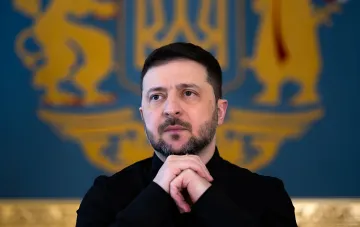
Cooperation between the two capitals has gone far beyond diplomatic declarations. A General of the UN Command, speaking the day before, noted that the war in Ukraine provided North Korea with a unique advantage: the opportunity to gain modern combat experience and test its own missile systems in real combat conditions. Ukrainian President Volodymyr Zelenskyy confirmed these fears, reporting that Russia had received new deliveries of ballistic missiles from North Korea. According to him, it is precisely participation in the conflict that allows Pyongyang to rapidly improve its missile potential, using data from the front lines.
Contradictory Data
The question of the scale of military interaction causes discrepancies in the assessments of the parties. On the one hand, Ukrainian intelligence and Western analysts report plans for Russia to attract up to 50,000 soldiers from North Korea to participate in hostilities, where they are to learn the tactics and technologies of modern warfare. On the other hand, official statements from Beijing and Pyongyang often focus on the trade and economic aspect of cooperation, avoiding direct confirmation of the mass transfer of manpower. The gap between intelligence data on the preparation of a contingent and diplomatic formulations about 'regional security' remains a key factor of uncertainty in assessing the real military ambitions of the alliance.
Diplomatic Context and Prospects
The Head of the North Korean Ministry of Foreign Affairs confirmed that she intends to convey Kim Jong Un's greetings from Vladimir Putin, which underscores the intensity of the diplomatic dialogue. In conditions where Pyongyang sees the exercises of the South and the USA as a threat to its existence, and Moscow needs the technological and resource assets of its ally, the alliance is transforming from formal to pragmatic. However, as experts note, such closeness inevitably provokes countermeasures from Washington and Seoul, increasing the risks of direct confrontation in the Asia-Pacific region.