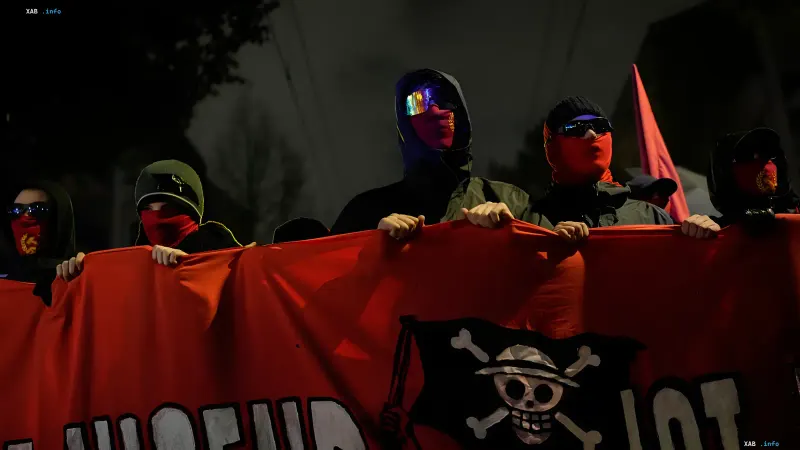
In political science, the term "Querfront" describes situational alliances of ideological opposites that unite against a common enemy. Historically, such intersections of left-wing and right-wing radicals were observed at anti-COVID protests or pro-Russian rallies. However, after the Hamas attack on Israel on October 7, 2023, a qualitatively new trend has emerged in Germany: a sustained rapprochement between left-wing extremists, Islamists, and militant pro-Palestinian networks. According to German intelligence services and political extremism experts, this is not a matter of isolated intersections, but a structural transformation of the radical landscape that affects both street protest activity and parliamentary politics.
Intelligence Services Note a Sustained Trend
The Federal Office for the Protection of the Constitution (BfV), regional offices in Berlin and Saxony, as well as the state security police, are officially documenting the formation of new radical networks in which German-born left-wing extremists act jointly with foreign Islamists and pro-Palestinian militants. Political extremism expert Professor Hendrik Hansen explains that both local activists and organizations from the spectrum of foreign extremism, which in turn have close ties to Islamists, are coordinated within these networks. According to him, social media is used for the mass dissemination of anti-Israel propaganda, and through the Federal Working Group "Solidarity with Palestine" and its Berlin equivalent, various groups exert significant influence on the Die Linke party and its parliamentary work.
Ideological Foundation: A Common Picture of the Enemy
The ideological cement of this alliance, according to Professor Hansen, is a unified view of the enemy: "They are united by hatred of the West and the conviction that the root evil in the world is imperialism, for which, in addition to Germany, the USA and Israel are primarily blamed." In this perspective, Israel is perceived as a "neocolonial" and illegitimate project. At the same time, as the expert emphasizes in an interview with Euronews, the ultimate goal of these groups goes far beyond the Middle East conflict: "The goal of these left-wing extremists and Islamists is the destruction of Israel. But their aspirations go beyond Israel and are directed against Western culture as a whole." The Gaza Strip has become a mobilizing symbol for modern radicals, similar to the Vietnam War for the "'68 movement," while the actual circumstances of the conflict — including Hamas's use of civilians as human shields — are ignored in their narrative.
Infiltration of Parliamentary Politics
The infiltration of radical networks into the legal political system causes particular concern among German security officials. Professor Hansen notes that within the left-radical scene, those who refuse to stand in solidarity with Islamists have become a minority. The Trotskyist network marx21, which operates within Die Linke, reportedly divides nationalism into "good" (Palestinian, because it is directed against oppression) and "bad" (German). The expert sees this as a direct consequence of a rigid binary division of the world: "Everything the oppressed do is by definition good and legitimate, and everything the oppressors do, regardless of what it is, is bad." It is through such ideological constructs, according to the BfV's assessment, that radical groups gain access to parliamentary structures and influence the agenda of Die Linke.
Historical Parallels and Key Differences
The cooperation of German leftists with Palestinian militants is not a new phenomenon: as early as the 1970s, the left-radical terrorist organization "Red Army Faction" (RAF), responsible for 34 murders, maintained close contacts with the Popular Front for the Liberation of Palestine (PFLP). However, as Hansen emphasizes, despite all the similarities, there are fundamental differences. In the era of the RAF, Islamism did not play a significant role, whereas today Iran, with which left-wing extremists "consciously or unconsciously" stand in solidarity, has taken center stage in the radical landscape. Furthermore, unlike the militants of the RAF, modern German-born left-wing extremists have not yet committed attacks with the intention of killing people. Explaining the paradoxical alliance of women's rights activists with ultra-conservative Islamists, the expert points to the primitivization of the world view: left-wing radicals are convinced that the patriarchal model of society in Islamic countries is formed exclusively by the oppression of capitalism and imperialism.
Threat of Escalation at Two Levels
Professor Hansen warns of the risk of a new form of terrorism that manifests at two levels. On the first — street violence: since October 2023, there has been a steady increase in the number of attacks on Israeli and Jewish institutions, as well as on Jewish citizens, in the context of anti-Israel demonstrations. On the second — the political level: these networks are playing an increasingly significant role in legal politics. In Berlin, according to the expert, there is a close interconnection between the Die Linke party and left-wing extremists, foreign radicals including PFLP supporters, and Hamas fans, including members of the Barbach clan. According to the researcher, similar processes of convergence between radical networks and left-wing political forces are already being observed in other European countries, making the German case not isolated, but part of a broader continental trend.