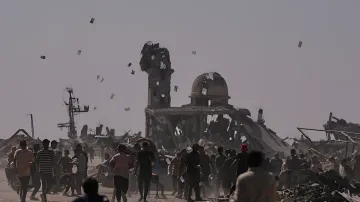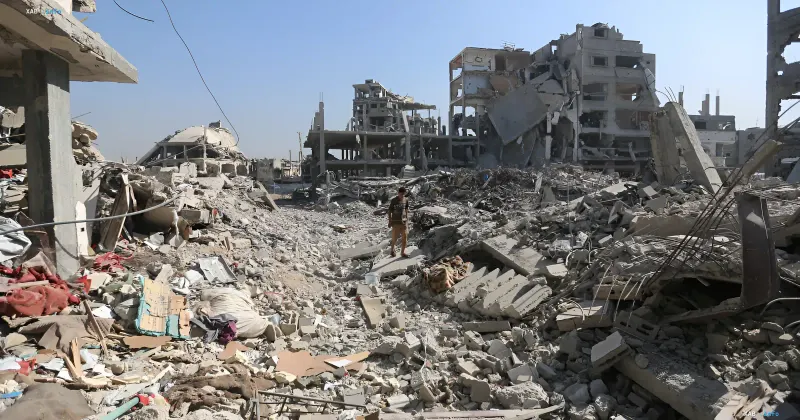
On Wednesday, November 18, 2026, dozens of Palestinians—most of whom have been displaced multiple times since the start of the 2023 war—abandoned their tents and shelters in central Gaza after Israeli tanks moved along the main north-south Salah al-Din road. According to eyewitnesses, the armored vehicles crossed the so-called "Yellow Line," a border separating the two-thirds of the Gaza Strip that remain under Israeli control despite a truce lasting over a year. The Israeli military command stated it was conducting an operation against "Hamas infrastructure" west of this line, confirming it is the first ground operation since the U.S.-mediated truce came into effect in October 2025.
Flight of the displaced and strikes on the same day
Residents, fearing the resumption of hostilities, loaded their belongings onto bicycles, wheelchairs, motorcycles, and cars to flee the area. A Palestinian woman, Salam Akl, said the military ordered locals to leave, but her family wanted to stay "because we are exhausted by multiple displacements"; she stated that as they sat down, fire broke out, and a boy was wounded in the leg. Palestinian medics reported that an Israeli airstrike near the site of the ground operation claimed one life, while earlier the same day, separate strikes in Deir al-Balah and Gaza led to the deaths of two more people, according to their data. An Israeli military spokesperson speaking to NBC News confirmed that forces also struck a militant in southern Gaza early Wednesday.
"Truce violation" versus "infrastructure operation"
Hamas called the Israeli raid and the forced displacement of Palestinians a violation of the ceasefire and a "dangerous escalation"; the Israeli military command did not immediately respond to these statements. Israel, which states that Hamas has recently been regrouping and rearming, has stepped up strikes against the organization, while Hamas accuses Israel of trying to wreck the U.S.-mediated agreement. The truce halted major combat operations but did not stop Israeli strikes or ensure Hamas's disarmament.
Board of Peace report: truce on the verge of collapse
On the same day, the body overseeing U.S. President Donald Trump's plan to end the war in Gaza, the Board of Peace, in a 12-page report to the UN Security Council, accused both sides of failing to fulfill their obligations to cease hostilities, leaving the population of Gaza in a dire situation and putting the truce at risk of collapse. This is the body's second report since the U.S.-backed truce took effect 13 months ago; its findings are expected to be presented at a Security Council meeting in New York in late November. "The distance between what was agreed and what is happening on the ground remains the main risk for the process," the report states, warning that "a truce that yields nothing visible cannot be sustained indefinitely."
Stall on disarmament and troop withdrawal plan
Although the truce halted major combat operations, the broader plan—Hamas's disarmament, the withdrawal of Israeli troops, and the start of reconstruction—has effectively stalled shortly after taking effect. Hamas agreed in July to the Board of Peace roadmap on surrendering weapons and transferring administration of Gaza to a civilian transitional body, but Israel rejected the roadmap, stating it would not withdraw troops until Hamas is dismantled. Israel continues near-daily strikes on Gaza, and according to the report, Hamas fighters also continue attacks on Israeli military personnel.
Casualty balance according to the parties
According to Palestinian health authorities, at least 1,600 Palestinians have been killed in Gaza since the truce came into effect, while the Israeli military command reports the deaths of five Israeli soldiers. Palestinian authorities point out that during the military campaign launched by Israel following the October 7, 2023, Hamas militant attack—which killed about 1,200 people in southern Israel—over 74,000 people have died in Gaza.