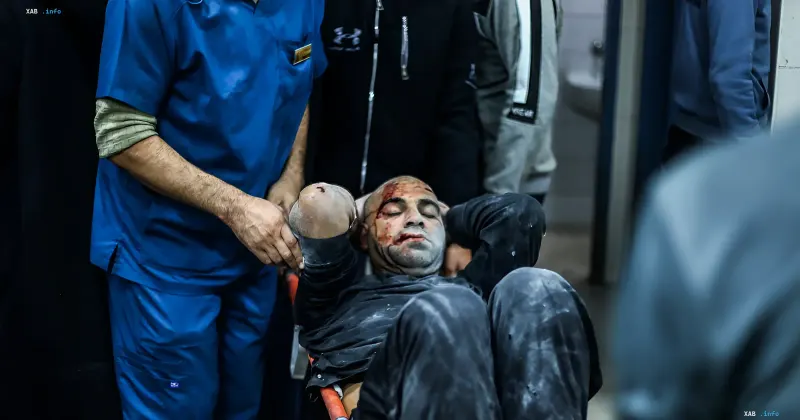
On Thursday night, November 12, the Israeli Air Force struck the surgical building of Nasser Hospital in Khan Yunis, in the southern Gaza Strip. According to the Palestinian enclave's Ministry of Health, at least six people were killed in the attack, and at least 20–28 others were wounded. Among the dead are 52-year-old Palestinian surgeon Rizk Abu Shaira, 13-year-old Jahad Naim Muhammad Abu Tilih, and Khaleda Abu Anza. The strike destroyed ceilings and left rubble in the wards of one of the few remaining functional medical facilities in Gaza after Israel's years-long military campaign.
"There was no warning"
The head of the surgical department at Nasser Hospital, Dr. Ayman Abu Obeid, stated that there was "no notification, no warning, or anything else" before the attack. "Suddenly there was fire and shelling, the walls collapsed instantly," he described the moment of the strike, which occurred shortly after midnight. According to him, only medical staff providing care to patients were in the building at that time. Two British surgeons—consultant in general and colorectal surgery Goher Rahbur and limb reconstruction specialist Stefan Werborg—confirmed they received no warning from the Israeli military. Werborg, who was 15–20 meters from the impact point, recounted: "I heard the impact and felt the blast because the whole hospital shook. You could smell the smoke and see the dust."
Israel: the target was the commander of the Khani Yunis brigade
The Israeli Air Force and the Israel Security Agency (Shin Bet) said in a joint statement that the target of the strike was Muhammad Abu Ismail, whom they identified as the commander of the Hamas Khani Yunis brigade, "responsible for holding hostages in Gaza." According to Israeli authorities, Hamas had "established a presence inside the hospital complex and used it as a command center," storing weapons and conducting interrogations and torture there. The statement also reported that measures were taken to "minimize harm to civilians, including the use of precision munitions and aerial surveillance," and that "prior warnings" were issued to the population. The Israeli military stated it is investigating reports of the deaths of medical staff and patients.
Dr. Abu Shaira: "Did not leave his post for a single day"
The deceased surgeon, Rizk Abu Shaira, was featured in the 2026 documentary "American Doctor," which followed three American doctors providing medical aid in Gaza. The Director-General of the Gaza Ministry of Health, Muhammad Zaqout, addressing a crowd of mourners by the body covered in a shroud, said: "Dr. Rizk was in the hospital throughout the entire war. He did not leave his duties for a single day." British surgeon Rahbur, who operated alongside Abu Shaira that same day, recalled that on Wednesday evening they were "laughing and joking" hours before their colleague's death. Both British doctors arrived in Gaza in early November through the British charity IDEALS, which provides humanitarian aid in conflict zones, and stated they saw no signs of Hamas presence in the hospital.
Hamas calls the attack a "brutal crime"
In response to the strike, Hamas stated it was a "brutal crime directed against a civilian medical facility." The attack took place amid an ongoing ceasefire supported by the United States, which observers note further exacerbates tensions surrounding the truce. Nasser Hospital confirmed the death of 53-year-old Khaleda Abu Anza, whose sister Tahani Ibrahim Abu Anza reported his death. The Israeli military, in turn, called Abu Anza a "Hamas operative," but his family did not directly confirm his involvement with the organization. The Israeli publication Ynet reported that the commander of the Khani Yunis brigade with the same name was killed in the strike, but the IDF stated it would "return to this matter."
Context: a hospital on the brink
Nasser Hospital in Khan Yunis remains one of the few functional medical facilities in the Gaza Strip after Israel's years-long military campaign, which, according to international organizations, has led to the destruction of a significant portion of the enclave's healthcare infrastructure. The strike on the surgical building deprived the region of yet another emergency care point. The total number of casualties is estimated by various sources at between 20 and 28; final figures were not reconciled at the time of publication.