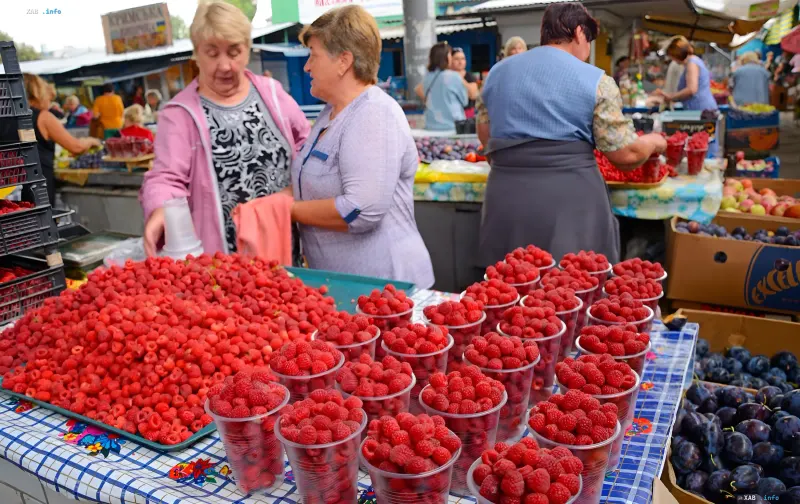
In the 2026 berry season on the Ukrainian market, raspberry has turned into one of the most expensive products on the shelves. According to data published by RBC-Ukraine, this week the price of the berry in the Sillpo supermarket chain reached at least 59.90 hryvnia per 100 grams, i.e. around 599 hryvnia per kilogram. In the VARUS chain, a kilogram of loose raspberry is priced at 279.90 hryvnia, while in Auchan Ukraine a 250-gram pack costs 237.20 hryvnia. Selling the berry pre-packaged — in 100, 125 or 250-gram portions — has become the norm, since raspberry quickly loses its marketable appearance and requires careful logistics.
A record in volume or in price?
Taras Bashtannik, President of the Ukrainian Fruit and Vegetable Association (UFVA), warned in a comment to the SEEDS publication against hasty conclusions about a "record" harvest. In his words, in physical terms there is probably less raspberry this year than last: "The yield this year has probably let farmers down. But the price — no." At the same time, in monetary terms the season may well turn out to be a record one precisely because of the high prices. Bashtannik recalled that prices for raw material for processing reached 193–195 hryvnia per kilogram excluding VAT, and emphasized that "this has never happened before."
Contradictory data
Here the versions of market participants diverge. A number of media outlets had previously reported yet another "record" in the raspberry sector, interpreting the high prices as a consequence of record volumes. However, the head of UFVA directly disputes this interpretation, pointing out that harvest volumes have, on the contrary, shrunk compared to the previous year, and that the rise in revenue is explained by price, not by quantity. Analysts at the EastFruit project support the second view: "Prices for raw material this high usually indicate not only strong demand, but also an insufficient supply of the berry of the required quality." Thus, the key feature of the 2026 season has been not a production record, but processors' competition for limited volumes of raspberry.
Why the berry remains exclusive
Experts explain the high cost and limited supply by the difficulties of harvesting. Raspberry for sale is hard to pick, and it is precisely this that holds back any significant expansion of new plantation areas, keeping the berry's status as an exclusive product. Combined with a shortage of raw material of the required quality, this sustains a persistently high price level both for raw material and on retail shelves.
The export channel defines the market
Domestic consumption of raspberry in Ukraine, according to Bashtannik's estimate, is "frankly small": 90–95% of the harvest goes to export, which he calls "very good for Ukrainian berry growers." EastFruit analysts add that domestic consumption — of both fresh and frozen berry — is not yet able to form a sales channel comparable in volume. Frozen raspberry is used in the production of yogurts, desserts, confectionery, beverages and smoothies, so Ukrainian raspberry, in the analysts' words, "has turned from a relatively local berry into an important export raw material for the European food industry." As a result, producers are increasingly dependent not on the situation on the shelves of Ukrainian supermarkets, but on processors' contracts with buyers in the EU.