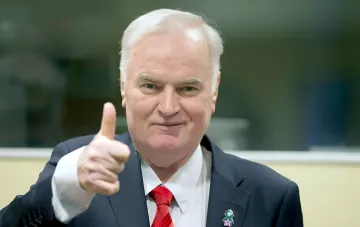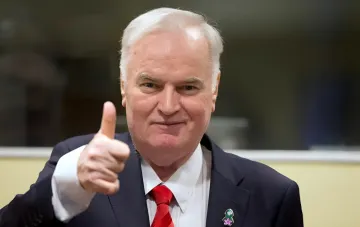
The funeral of Ratko Mladić, the former commander of the Army of Republika Srpska, was held in Belgrade. He had been sentenced to life imprisonment by the International Criminal Tribunal for the former Yugoslavia for genocide. Thousands of people, including members of the government, came to pay their last respects to the convicted war criminal, who died in a prison in The Hague at the end of August. The ceremony, accompanied by military honours, has already provoked a sharp reaction from European institutions and called into question Belgrade's European prospects.
A ceremony with the hallmarks of a state ritual
Mladić's coffin was placed in the Church of Saint Luke, with a military cap, a saber and decorations displayed beside it, while servicemen stood guard by the coffin. After the church service, the procession moved to the cemetery, where the burial took place with military honours, including a three-volley salute. Formally, the ceremony was not declared a state funeral, yet by its scale and the presence of security structures it bore all the hallmarks of a state event: several Serbian ministers, the son of the President of Serbia, Danilo Vučić, and the Russian ambassador were present. The head of state, Aleksandar Vučić, himself did not attend the ceremony.
Sharp reaction from European institutions
European Commissioner for Enlargement Marta Kos cancelled her planned visit to Serbia, calling the glorification of Mladić 'incompatible with European values'. She emphasised that the European path requires a reckoning with the past, genuine reconciliation and respect for the victims of war crimes. An EU representative separately stated that there is no place in the Union or in candidate countries for the glorification of war criminals, the denial of genocide or historical revisionism. Council of Europe Commissioner for Human Rights Michael O'Flaherty also condemned the public glorification of Mladić and called on authorities to fight against the heroisation of convicted war criminals.
Contradictory data
There is an inconsistency in the available reports regarding the age at which Mladić died. Some formulations state that he died at the age of 84, while others say 85. Both versions appear in the primary materials, and a final clarification requires additional verification. In addition, the sources stress that for his crimes Mladić served only about 15 years of his life sentence, which also raises questions about the actual enforcement of the verdict.
Historical context: the tribunal's verdict
Mladić, nicknamed the 'Bosnian butcher' by the media for his brutality, was found guilty in 2017 of genocide in Srebrenica, crimes against humanity and war crimes, and was sentenced to life imprisonment. The key episode was the killing of around 8,000 Bosnian Muslim men and boys in Srebrenica in 1995. He was also found responsible for his role in the siege of Sarajevo, which lasted 1,460 days and claimed the lives of more than 10,000 people. The war in Bosnia and Herzegovina took around 100,000 lives, and more than 2 million people were forced to leave their homes.
A blow to Belgrade's European ambitions
Serbia has been negotiating EU accession since 2014, but in recent years the process has stalled. A new wave of criticism from Brussels against the backdrop of Mladić's funeral creates additional problems for Belgrade's European ambitions. Croatian Prime Minister Andrej Plenković warned that the heroisation of Mladić could negatively affect Serbia's prospects, stating that it is 'as if they are closing the door on the European Union themselves'. Meanwhile, in Russia condolences were expressed to the family of the deceased, and the Kremlin once again did not recognise the verdict of the Hague tribunal.