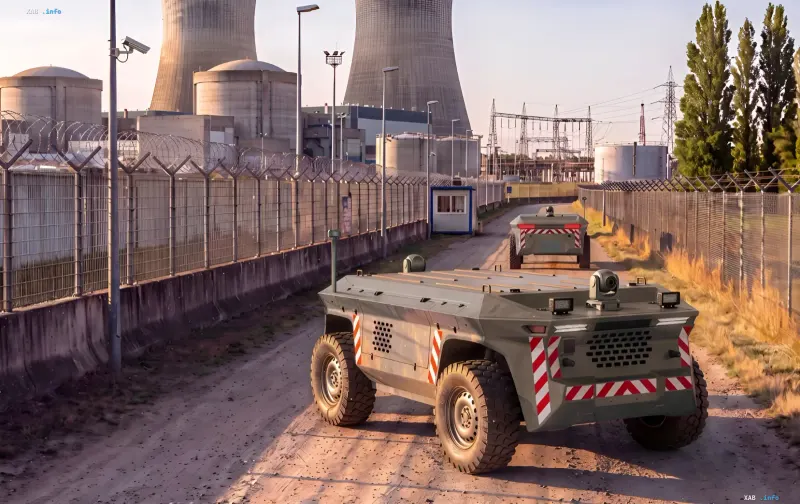
Renault Group has officially unveiled its modular Unmanned Ground Vehicle (UGV) named Forefront Concept — a remotely operated platform built upon proven automotive technologies and components. This is reported by RBC-Ukraine, citing the company's press office. The primary design focus was on reducing production costs and accelerating the path to mass production by utilizing an existing automotive component base rather than developing all systems from scratch. At the same time, the design incorporates requirements from the French military, while remote control and autonomous driving technologies were developed by the Belgian company John Cockerill.
Architecture: automotive base instead of a "blank sheet"
The key architectural decision for the Forefront Concept is its modularity and reliance on civilian automotive engineering. Renault Group is responsible for the platform itself: the chassis, suspension, transmission components, and body solutions are borrowed or adapted from the group’s existing mass-produced technologies. This approach, according to the manufacturer, significantly lowers unit costs and shortens the cycle from design to mass production. The design includes two electric motors and an all-wheel steering system, ensuring all-wheel drive and high maneuverability on rough terrain. The exact specifications of the main battery and the auxiliary energy block have not yet been disclosed by the company.
Autonomy and remote control
The new ground drone can be operated remotely by an operator or used in a fully autonomous mode, allowing the machine to navigate complex and dangerous areas on its own. The development of remote control technologies and autonomous driving algorithms was handled by John Cockerill, a company specializing in defense and aerospace solutions. The combination of the "automotive" chassis from Renault and the "defense-grade" electronics from Cockerill forms the platform's competitive advantage: the operator receives a combat-ready unit without the need for deep reconfiguration, and the autonomous module enables tasks in areas where direct operator contact is not permissible.
Technical characteristics and range
According to the manufacturer, the Forefront Concept can cover about 400 km on a single battery charge. This figure can be increased by installing an additional module that acts as a range extender — essentially a swappable energy block that attaches to the platform in a modular fashion. The vehicle's payload capacity is up to 1000 kg, which opens up a wide range of tactical tasks: from cargo transport and logistics support for units to counter-drone operations, fire support, and casualty evacuation. The specific weight, speed, and approach angles were not included in the press release.
Testing and the path to mass production
The French Armed Forces plan to test the Forefront Concept during upcoming exercises and specialized trials. Based on these results, Renault will implement necessary design changes and improve the development based on operational feedback. The company emphasizes that the new remotely operated platform was created with an eye toward affordable costs and the ability to rapidly scale production. While pricing information has not been released, Renault indicates that if there is sufficient demand, the Forefront Concept could see further development and move into the mass production phase. Thus, at the current stage, the platform is in the demonstration and preliminary troop trial phase, rather than full-scale production.
Context: accelerating the ground drone race
The presentation of the Forefront Concept comes amidst a noticeable acceleration of the global race in the UGV segment. It was previously reported that the Croatian UGV Komodo from Rheinmetall successfully passed bridge-laying trials in September 2026 — a task requiring high positioning precision and chassis stability. It also became known that the 3rd Army Corps became the first in the world to air-drop a UGV from bombers directly into enemy territory, marking the transition of robotic equipment from "frontline support" to "deep deployment" status. In this context, the Forefront Concept, with its modular architecture, 400 km range, and one-ton payload, is positioned as a versatile platform capable of performing multiple roles depending on the installed module.