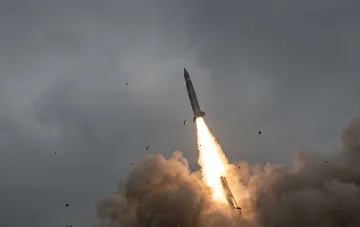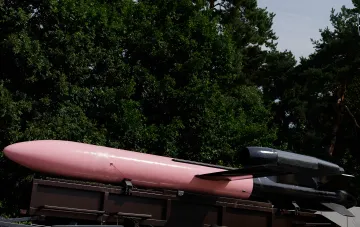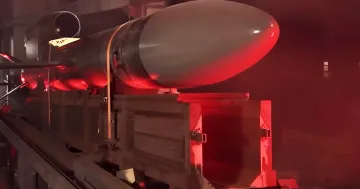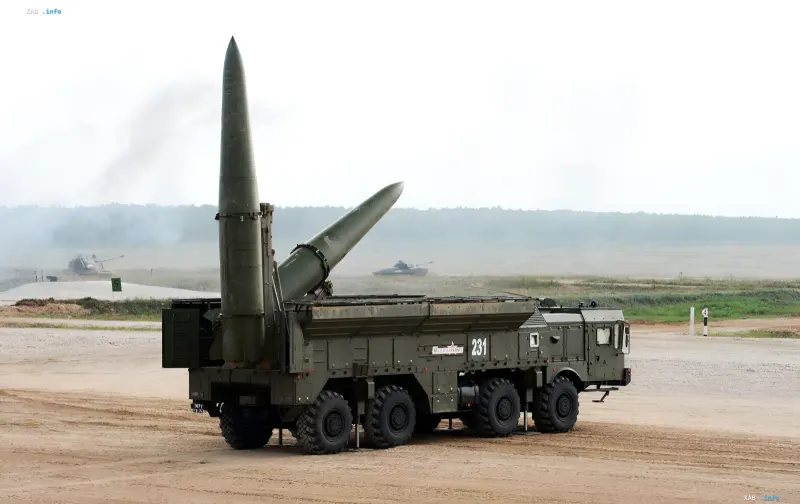
Ukraine will only gain the ability to effectively counter Russian ballistic missiles once it receives its own serial-produced ballistic missiles. This was stated by aviation expert Konstantin Krivolap in a comment to RBC-Ukraine. In his opinion, the key to victory in this confrontation lies in destroying the enemy's launchers before they launch.
The Hidden Threat: Where 'Iskanders' Hide
According to the expert, Russian launchers capable of attacking the Ukrainian capital are located deep within the territory — 200–250 kilometers from the border. Over the past few years, only a few confirmed cases of strikes on 'Iskander' Operational-Tactical Missile Systems (OTMS) have been recorded. The main reason for the difficulty in detecting them lies in their storage and deployment tactics.
In most cases, these systems are stored in caponiers at military airfields, where large aviation storage facilities are located. It is practically impossible to notice the deployment of ground complexes to combat positions without the help of specialized equipment. The perimeters of such airfields are under heavy guard, making visual observation by ordinary people meaningless.
A Race Against Time: Aviation vs. Missiles
The only way to detect the movement of an 'Iskander' is to use long-range reconnaissance drones. However, even with successful detection, a critical problem arises regarding the time factor. As soon as the drone transmits data to the command post, a chain of orders for combat aviation is initiated.
While Ukrainian aircraft take off and cover the distance to the target, the Russian OTMS has time to arrive at its position and launch an attack. Time calculations show that the trip to the launch position takes 40–50 minutes, and deployment takes another 20 minutes. This means that for success, the aviation must outpace the Russian crew, which is extremely difficult under current conditions.
The Solution: Speed of Own Ballistics
The expert is confident that the situation could be radically changed by the appearance of Ukrainian ballistic missiles, such as the FP-7. These missiles, produced by Fire Point, are capable of covering distances of 250–300 kilometers and delivering strikes at high speed.
The logic is simple: the number of locations for launches is limited. When the complex arrives and begins to deploy, it can be struck by its own ballistics. According to Krivolap, it is enough to destroy 2–3–5 complexes for the remaining Russian crews to think twice about the expediency of going to positions. In conditions where every deployment threatens destruction, further attacks will become suicide for the enemy.
Context: Russian Weapons Production
Questions regarding the effectiveness and origin of weapons remain at the center of attention. Previously, the Main Directorate of Intelligence (GUR) of the Ministry of Defense of Ukraine reported that Russia uses Japanese and Chinese machine tools to produce guided air bombs (GAB), missiles, and artillery ammunition.
The department also noted the discovery of 68 new components in Russian missiles and drones used to attack Ukrainian energy facilities. These data highlight the complexity and technological nature of the modern conflict, where the struggle takes place not only on the battlefield but also in the sphere of supply chains and technologies.