In August 2026, Russian border checkpoints recorded a systemic trend of increasing refusals to cross the state border for men of conscription and mobilization age. Unlike the autumn of 2022, when lists were formed primarily manually at the level of individual border outposts, by the current time the FSB Border Service has switched to operating with automated state databases, which significantly increases the speed and predictability of blocking decisions. This shift from ad-hoc practices to institutionalized digital control represents a qualitatively new stage in the mechanism for restricting the right to leave the country, enshrined in Article 7.1 of Federal Law No. 53-FZ "On Military Duty and Military Service".
Architecture of automated control at border checkpoints
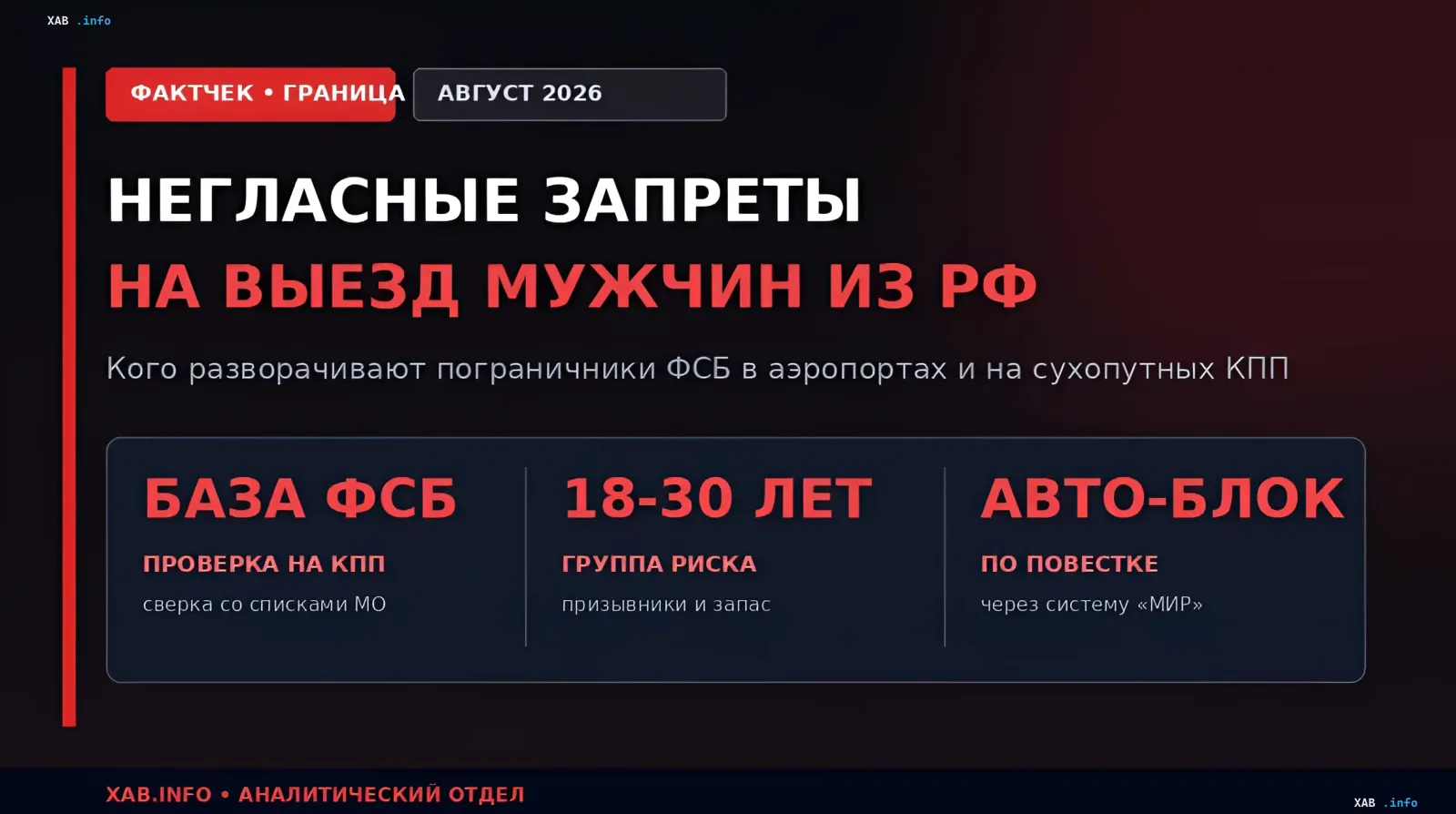
The passport control procedure in international airports (Sheremetyevo, Vnukovo, Domodedovo, Pulkovo) and at land border crossing points in 2026 operates through the state information system "Mir", synchronized with the databases of the Ministry of Internal Affairs and the Ministry of Defense. When scanning a foreign passport, the system automatically cross-references the citizen's data with the Unified Military Registration Register and the Summons Register. In the event of a record indicating a formed restriction, the system generates a signal flag "Departure Restricted", which gives the border guard an unconditional basis for refusal without the need for additional coordination. For men aged 18 to 30, as well as reservists with in-demand military specialties, an additional stage is provided: a referral for an interview to clarify the purpose of the trip, the presence of a return ticket, and the current military registration status. According to The Moscow Times, this procedure has become a routine practice, not an exception.
Categories of citizens in the maximum risk zone
According to a summary by human rights organizations and specialized lawyers presented by the publication "Important Stories", the highest level of risk when passing border control is borne by three categories of citizens. The first is conscripts aged 18–30 who do not have a formalized and registered deferment (for studies, health status, or family circumstances). The second is recipients of electronic summons, who were sent a summons "for data clarification" or for a medical commission via the Gosuslugi portal or the register. The third is reserve officers and persons with mobilization orders who are on special registration at military commissariats of certain subjects of the Russian Federation. It is for these groups that the "Mir" system is most likely to generate a blocking flag before the citizen actually approaches the border guard.
Legal grounds and appeal procedure
In the event of a refusal to cross the border, the border authority is obliged to issue the citizen an official written Notification on the Restriction of the Right to Leave, specifying the specific article of the law and the name of the authority that imposed the restriction (usually the military commissariat of the subject of the Russian Federation). The appeal mechanism is limited to two channels: applying to the military commissariat that imposed the restriction or filing a lawsuit in court. The practical significance of these procedures at the moment is minimal: even with a successful appeal over the course of several weeks, the planned flight or trip is ruined. Legal uncertainty is exacerbated by the fact that the criteria for forming a record in the register and the procedure for its removal are not disclosed in the public domain, creating a situation where the citizen learns of the restriction only at the moment of attempting to leave.
Macrocontext: from manual lists of 2022 to digital registries
The transition from manual list formation to the automated "Mir" system reflects a broader trend towards the digitization of state control and repressive functions. If in 2022 restrictions on leaving the country were of a local, not always documented nature, by 2026 they have been institutionalized and integrated into a single digital circuit of interaction between the FSB, the Ministry of Internal Affairs, and the Ministry of Defense. This means that the risk of blocking departure becomes not random, but structurally predictable for certain demographic and military registration cohorts. For the macroeconomic environment, this creates an additional factor of uncertainty: restricting the mobility of the workforce of conscription age affects the personnel potential in both the military and civilian sectors, as well as migration flows and the investment climate in the long term.
Contradictory data
Within the framework of the operational fact-check, a significant asymmetry in available public data was identified. On the one hand, the main material records a systematic tightening of control over the departure of men of conscription age through automated registries. On the other hand, available external sources (Interfax, August 2026) document the resumption of a simplified procedure for the departure of Russian children to Abkhazia with a birth certificate, which indicates a selective, differentiated approach to border control. At the same time, official explanations regarding the criteria by which the "Mir" system generates a blocking flag and the procedure for lifting restrictions are absent in the public space. The sources cited in the main material (The Moscow Times, "Important Stories") are not included in the list of verified external sources, which limits the possibility of independent cross-checking of specific figures and procedural details.
Thus, as of August 2026, the mechanism for restricting the departure of men of conscription age from Russia represents a mature, automated system integrated into the state digital circuit. The practical consequences for citizens are irreversible at the moment, while legal protection mechanisms remain formally available but practically ineffective in the short term. The further evolution of this system will be determined by both the military-political conjuncture and the degree of public transparency of the criteria for forming registry records.